Why Are My Amazon Sales Low? A Strategic Guide for Brand Owners
When you're staring at a sales slump, the question "Why are my Amazon sales low?" feels complex. The answer is not.
Your sales aren't tanking because of a mysterious algorithm change. It boils down to one of two failures: not enough shoppers are finding your product (a traffic problem), or the shoppers who do find it aren't buying (a conversion problem).
That’s it. It’s one or the other. Your job is to diagnose which one, then act decisively.
The Only Two Reasons Your Amazon Sales Are Low
Before you slash prices or crank up your PPC budget, you must get the diagnosis right. Making the wrong move is expensive. Pouring ad spend on a listing that doesn’t convert is like trying to fill a bucket with a hole in it. Perfecting a listing nobody ever sees is just as fruitless.
Amazon gives you all the data you need to stop guessing. Your diagnosis comes down to two numbers inside Seller Central:
- Sessions (Traffic): The number of unique shoppers who visited your product detail page. This is the foot traffic to your digital storefront.
- Unit Session Percentage (Conversion Rate): The percentage of visits that turned into a sale. This tells you how effectively your listing persuades buyers.
Looking at these two metrics together tells you everything. High Sessions but a low Unit Session Percentage is a dead giveaway you have a conversion problem—your listing isn't convincing people to buy. Low Sessions, regardless of conversion rate, means you have a traffic problem—people can’t buy what they can’t find.
This decision tree breaks it down. It’s the simplest way to see the split.
This framework strips away the noise and points you in the right direction: get more eyeballs on your listing, or do a better job selling to the ones you already have.
Diagnosing Your Sales Problem: Traffic vs. Conversion
To put this into practice, pull up your Business Reports in Seller Central and navigate to the "Detail Page Sales and Traffic by ASIN" report.
This table helps you interpret the numbers and define your next move.
| Symptom | Metric to Check | What It Means | Primary Action |
|---|---|---|---|
| "No one is visiting my store." | Sessions are low compared to competitors. | You have a traffic problem. Shoppers aren't seeing your listing. | Focus on visibility: improve your main image to win the click in search results. |
| "People are looking, but they're not buying." | Unit Session Percentage is low. | You have a conversion problem. Your listing isn't persuasive. | Focus on your detail page: upgrade your product listing imagery. |
| "Traffic is high, but my PPC spend is killing me." | Ad Spend is high, ACoS is unsustainable. | You have an inefficient traffic problem, likely driven by a conversion issue. | Fix your listing's conversion rate first. Better images improve PPC efficiency. |
| "Sales are okay, but I keep running out of stock." | In-Stock Rate is below 95%. | You have an inventory problem, which hurts both traffic and conversion. | Improve inventory forecasting and management to maintain stock levels. |
By comparing your metrics against these symptoms, you can pinpoint the core issue. This diagnosis is the single most important step. It defines your entire strategy and ensures every action is aimed squarely at the real problem.
Fixing Your Conversion Problem Starts and Ends with Images
You’ve diagnosed a conversion problem. People find your listing, click on it... and then vanish. Why?
Your page isn’t convincing them to buy, and the primary culprit is your images. Your visuals do the heavy lifting long before a shopper reads a single bullet point.
Images sell first. Copy sells second. In the blink-and-you-miss-it world of Amazon, your image stack is your most powerful salesperson. This isn't about "pretty" pictures. It’s about a strategic set of visuals designed to answer questions, handle objections, and build trust faster than your competition. A low conversion rate with healthy traffic is a flashing red light that your images are failing.
Common Image Mistakes That Destroy Conversion
Too many sellers treat their image block like a photo gallery. This is a fatal mistake. A passive, "here's the product" approach is why listings with good traffic don't sell. The most common errors are predictable and easy to fix.
- Relying on Generic Stock Photos: Using lifestyle photos that aren’t specific to your product screams low effort and kills trust. Shoppers spot lazy, irrelevant imagery from a mile away.
- Overloading Infographics with Text: Cramming every feature into one image creates a wall of text that's impossible to read on a phone. If a shopper has to pinch and zoom, you've already lost.
- Failing to Show Scale and Context: A product floating in white space gives the buyer zero sense of its size or how it fits into their life. That uncertainty creates doubt, which leads directly to abandoned carts.
These aren't cosmetic issues; they actively sabotage your sales by creating confusion and friction. They are a direct cause of low Amazon sales.
Your image set isn't a portfolio; it's a strategic argument. Each image must have a purpose: to overcome a specific buyer objection, highlight a key benefit, or demonstrate a unique value proposition that your competitors miss.
Auditing Your Images for Conversion Strength
To fix your conversion problem, you must get inside the head of a skeptical buyer. Your images need to walk them through a visual sales pitch, answering every question and calming every fear. This takes research, not guesswork.
Start by digging into your customer reviews and Q&As. Then, do the same for your top three competitors. You're looking for patterns—recurring questions, common complaints, and consistent praise. These are the exact objections and desires your images must address.
If customers constantly ask about durability, your images need to show the product withstanding stress. If they complain a competitor's product is too small, your images must clearly demonstrate scale next to a common object. This simple process turns passive pictures into active selling tools. For a deeper look at turning visitors into buyers, check out these strategies on how to improve your conversion rate.
Optimizing Images is No Longer Optional
Visuals are the single most important lever for conversion. This isn't just an opinion; it's a market reality driven by Amazon's own AI.
Amazon's new shopping assistant, Rufus, has already reached over 300 million users, and those shoppers have a 60% higher purchase rate than people using the old search bar. Sellers who optimize their listings for this AI—using high-quality, benefit-focused images—are reporting 20-25% sales increases. Meanwhile, those with outdated imagery are getting left behind.
This isn't about looking good. It's about feeding Amazon's AI the clear, structured visual data it needs to understand and recommend your product. High-quality, benefit-driven images are no longer a "nice to have"—they are the foundation of a high-converting listing.
For more advanced strategies, you can explore our other articles on improving your Amazon presence. Once you treat images as your primary conversion driver, you’ll stop asking why sales are low and start building a listing that sells.
Solving Your Traffic Problem in Search Results
If your data points to a traffic problem, you're losing the battle on the Amazon search results page. Simple as that. Shoppers are seeing your product—you're getting impressions—but they're scrolling right past it.
Before you can worry about your bullet points or A+ Content, you must win the click. You can't convert a customer who never makes it to your page.
Low traffic boils down to two elements that control your click-through rate (CTR): your main image and your price. That's it. These two elements create a shopper's first impression, instantly setting their expectation of your product's quality and value. Your images are the primary driver here.
Your Main Image Is Your Billboard
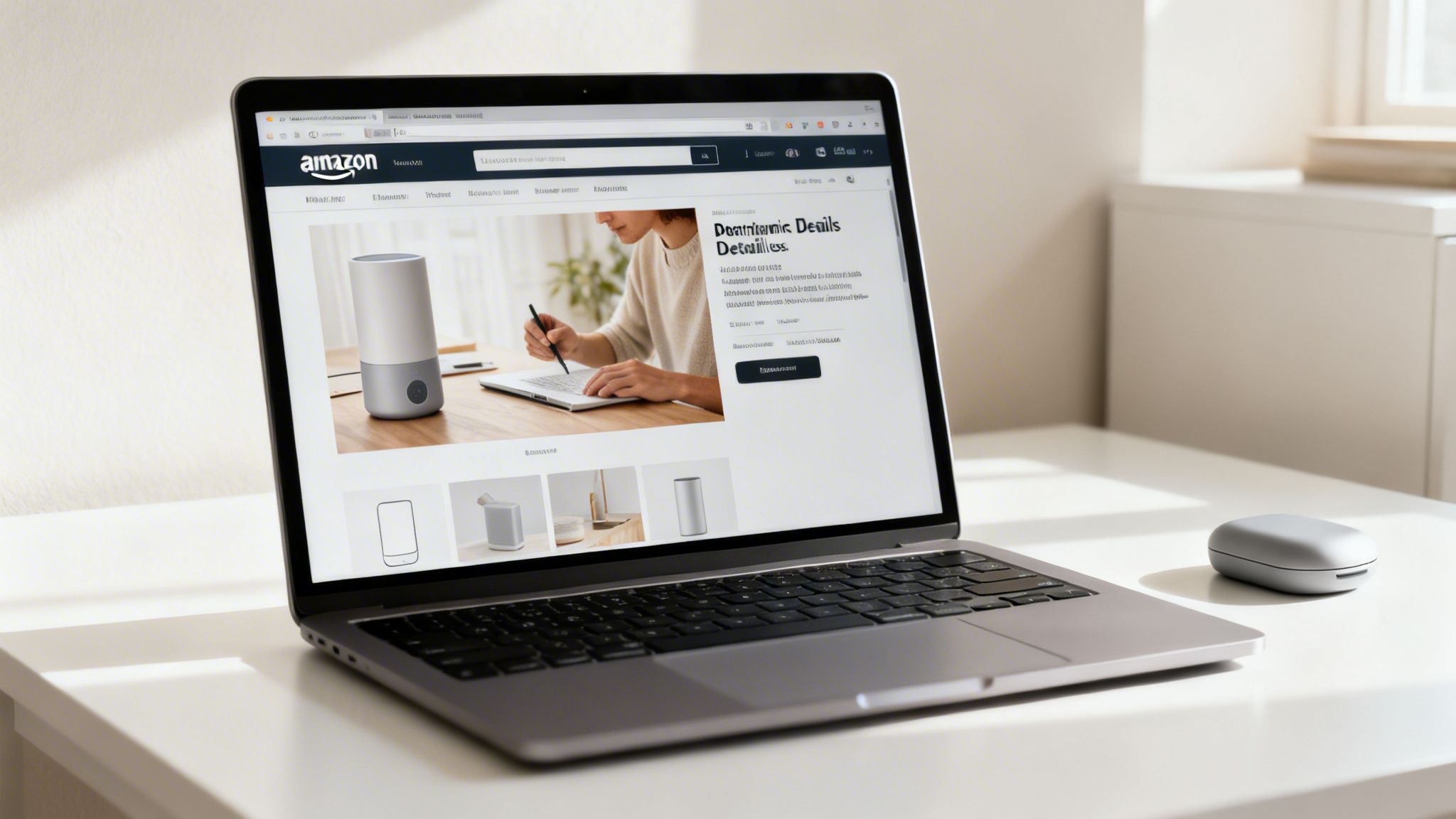
Think of your main image—your hero image—as a billboard on a crowded highway. It's your single most important tool for fixing a traffic problem. A generic, poorly lit photo makes your product look cheap and invisible, guaranteeing it gets ignored.
A great hero image does more than follow Amazon's rules about white backgrounds. It’s strategically designed to stand out. Its only job is to stop the scroll and make someone curious enough to learn more.
Most sellers make the same costly mistakes:
- Bad Scale: The product looks tiny in the frame, making it impossible to see on a mobile screen.
- Flat Lighting: Terrible lighting washes out details and makes the product look flimsy and low-quality.
- Awkward Angles: The product is shot from an angle that doesn't clearly show what it is or what it does.
These mistakes make your product forgettable. A winning hero image, on the other hand, is engineered to be bold, clear, and instantly understood, even as a tiny thumbnail.
The Psychology of a High-CTR Hero Image
To build an image that gets clicks, you must think like a shopper. People make split-second judgments based on visuals. Your hero image has to answer their subconscious questions and signal that your product is the best choice on the page.
What makes a hero image work? It taps into key psychological triggers:
- Visual Clarity: The shopper knows exactly what they're looking at in under a second. No guesswork.
- Perceived Quality: Professional lighting and crisp focus send a powerful signal: this is a high-quality product worth the money.
- Implied Value: Showing the full set of items or included accessories in a clean layout immediately communicates a great deal.
A great main image doesn't just show the product; it frames it as the solution. It grabs attention, communicates quality, and creates enough curiosity to earn the click over dozens of competitors on the same page.
How to Analyze and Outperform Competitors
Your competitors' biggest weaknesses are your greatest opportunities. Search for your main keyword and look at the top 10 results. What do you see? Are all their hero images the same? Same angles, same layouts, same boring shots?
Find the pattern, then break it.
If every other water bottle is standing straight up, shoot yours at a dynamic 45-degree angle. If they all show just one item, create a clean composition showing your product and its key accessories. This visual difference stops the scroll and pulls a shopper’s eye to your listing.
Your price and image must work together. A premium-looking photo can justify a higher price, while a cheap-looking one makes even a low price seem suspicious. The goal is alignment—your image sets an expectation of quality that your price confirms. Master this, and you will fix your traffic problem.
Winning the Buy Box Is Not a Passive Activity
You can have the best images on Amazon and perfectly optimized copy, but if another seller nabs the Buy Box, your sales will flatline. It's a brutal reality.
A sudden sales drop on a high-traffic listing often isn't a traffic or conversion problem at all—it's a Buy Box problem. Losing this critical placement is one of the most common, and most overlooked, reasons for an empty shopping cart.
Many sellers think the lowest price wins. That’s a dangerous oversimplification. The Buy Box algorithm is a complex beast, weighing dozens of factors to decide which seller offers the best overall customer experience. It's not a "set it and forget it" game; it's an active, daily fight for the top spot.
The Buy Box Bottleneck
Think about how you shop on Amazon. You see a product, you click "Add to Cart." You don't scroll down to check other offers. Your customers are the same.
Marketplace data shows that a staggering 82% to 90% of all sales go through that single button. If you don't own it, you're practically invisible.
This creates an intense bottleneck. While top sellers might hold a Buy Box share of 15% or more, many others are stuck in the 2% to 5% range. The math is simple and harsh: a 3% Buy Box share means you're losing 97% of potential sales to your competitors—on your own listing. With third-party sellers now accounting for over 60% of Amazon's U.S. sales, the pressure to dominate the Buy Box has never been higher. You can get a deeper dive into these numbers with the latest key statistics on Amazon sellers.
Key Factors in the Buy Box Algorithm
So, how do you win it? You need to think like Amazon. Their algorithm is designed to reward sellers who deliver a perfect customer experience. Price matters, but it's just one piece of the puzzle.
There are four core pillars that decide who gets the Buy Box:
- Fulfillment Method: Fulfillment by Amazon (FBA) is king. The algorithm heavily favors FBA's guaranteed fast shipping and reliable service. The only exception is for Fulfillment by Merchant (FBM) sellers with a flawless Seller Fulfilled Prime track record.
- Landed Price: This is the total cost to the customer—product price plus shipping. Being competitive here is non-negotiable, but you don't always have to be the cheapest if your other metrics are rock-solid.
- Seller Performance Metrics: Amazon is watching your account health like a hawk. Things like your Order Defect Rate (ODR), Late Shipment Rate, and customer response time are huge. A healthy account signals you're a reliable seller.
- Inventory Health: You can't win the Buy Box if you're out of stock. Period. Consistently low inventory will push the algorithm to favor other sellers, even if your price is better.
The Buy Box isn't a prize for the cheapest offer; it's a reward for the most reliable offer. Amazon prioritizes the seller least likely to cause a headache for the customer, and every metric it tracks is a proxy for that reliability.
The Overlooked Role of Conversion Rate
This is where your images and listing quality come full circle and directly impact the Buy Box, creating a powerful feedback loop.
A high Unit Session Percentage (your conversion rate) is a massive signal to Amazon that customers prefer your offer. When a shopper lands on the page and buys from you, it tells the algorithm that your combination of price, shipping, and listing quality is the most compelling.
This gives you a serious competitive edge. A strong conversion rate can actually boost your Buy Box eligibility, letting you win the sale even if your price is slightly higher than a competitor's. Amazon’s goal is a successful sale, and a high CVR proves you can deliver one.
This is why great images are a force multiplier. They don't just get more people to click "buy"—they feed positive data back to Amazon's algorithm, helping you win the Buy Box more often. This drives more sales, which creates more positive data, spinning up a flywheel that lifts your entire performance. If you neglect your images, you're fighting for the Buy Box with one hand tied behind your back.
The Profitability Paradox Hiding Your Real Sales Problem
Sometimes, the real reason your Amazon sales feel low has nothing to do with traffic or conversion rates. You might be moving a decent number of units every month, but the cash hitting your bank account just doesn’t add up.
This is the profitability paradox. And it’s a massive blind spot for even the most experienced sellers.
You’re not going crazy. Your profits are disappearing, making it feel like sales have fallen off a cliff even when your unit volume is holding steady. The real culprit isn't a lack of customers—it's the slow, silent death of your profit margins.
Every single year, it gets more expensive to play in Amazon's sandbox. FBA fulfillment fees creep up. Storage costs balloon. And the price of a single click on Amazon Advertising is always climbing. A product that was a cash cow two years ago might be a break-even SKU today, without you ever touching the price.
Your Revenue Is a Vanity Metric
Gross revenue looks great on a spreadsheet, but it doesn't pay the bills. Net profit does.
Fixating on your top-line sales number while ignoring how much you actually keep from each sale is the fastest way to run a very busy, very broke business. You end up dumping more cash into ads to chase sales that aren't even making you money.
It’s a vicious cycle. You see "low sales" in your financial reports, so you crank up the ad spend. This pushes revenue up but crushes your margins even further, making the core problem worse. The only way out is to stop obsessing over revenue and start auditing your profitability, ASIN by ASIN.
Conducting a Simple Profitability Audit
You need to know exactly where every dollar is going. This doesn’t require fancy software, just an honest look at your numbers.
- Calculate Your Landed Cost: What does it cost to get one unit to Amazon? This includes manufacturing, shipping, import duties—everything.
- List All Amazon Fees: Pull your reports. Note the FBA fee, referral fee (their commission), and any other little fees for that specific SKU.
- Factor in Storage Costs: Estimate the average monthly and long-term storage fees per unit. This number gets ugly fast, especially for slow-moving inventory.
- Add Your Advertising Cost: What’s your average ad cost to sell one unit? Just divide your total ad spend by the total units sold. This is often called TACoS (Total Advertising Cost of Sale).
- Account for Everything Else: Don't forget the costs of returns, disposal fees for damaged goods, and any operational overhead.
Now, subtract all of that from your sale price. The number left over is your true net profit per unit. I guarantee you’ll be shocked by how thin the margins are on some of your "bestsellers."
Understanding this is the first step toward making smart decisions. A solid grasp of financial metrics, like the difference between ROI vs ROAS, is also crucial for diagnosing profitability issues that revenue figures alone will never show you.
Profit margins have been squeezed hard, creating a paradox where sellers can be "profitable" yet constantly starved for cash. While 58% of Amazon sellers report making a profit in their first year, that profit is shrinking. Today, typical margins are 10-20% after all fees. Just a few years ago, 15-25% was standard—that’s a 20-33% drop in per-unit profitability. This is why revenue feels low even when unit volume is stable.
This margin compression is the hidden thief. Your audit will shine a light on which products are actually moving your business forward and which are just spinning their wheels. With that clarity, you can set better prices, make smarter ad buys, and maybe even kill off the products that are bleeding you dry.
It’s not about selling more. It's about earning more from everything you sell. And if our services, like our images, ever fall short of helping you do that, you can always check our straightforward refund policy.
Your Prioritized Action Plan to Revive Sales
When sales tank, it's easy to get trapped in "analysis paralysis." You start tweaking everything at once—PPC, price, keywords—and have no idea what's actually working. Stop.
The goal isn't to do everything. It's to do the right thing first. Every day you spend guessing is another day of lost revenue and tanking rank. This is your action plan, broken down by your specific problem.
If You Have a Conversion Problem
Your traffic is fine, but your Unit Session Percentage is in the gutter. This means people are visiting your page but not buying. Don't throw more ad money at it. That's like pouring water into a leaky bucket.
Your only job is to fix the bucket—your product detail page. The plan is simple and ruthless.
- Start with Images, End with Images: This is it. This is the single biggest lever you can pull. Audit your images by digging through customer reviews (yours and your competitors'). Your new image stack needs to crush the top buyer objections and visually scream your unique value.
- Reinforce with Copy: Once your new images are live, rewrite your title and bullets to match the story your visuals are telling. If image two shows the key benefit, that benefit should be front and center in your bullet points. Make it seamless.
- Validate with A/B Testing: Don't guess if it worked. Prove it. Use Amazon’s "Manage Your Experiments" tool to test your new main image against the old one. The data will tell you if you’ve fixed your conversion rate.
If You Have a Traffic Problem
If your Sessions are low, your listing is basically invisible. It doesn't matter how great your product page is if no one ever gets there. Your entire focus needs to be on getting the click.
Here’s your plan, in order.
- Optimize Your Main Image: Think of your hero image as a tiny billboard in a sea of other billboards. It has to grab attention and communicate value in a split second. Look at what your top competitors are doing, then design something that breaks the pattern and stands out.
- Test Your Pricing Strategy: Price and the main image are a tag team. After your new hero image is live, test small price tweaks. Find that sweet spot where you get the most clicks without destroying your profit margin.
- Refine Your Keywords: With a newly optimized image and price, you need to make sure you’re showing up for the right searches. Double-check that your title and backend search terms are packed with the highest-volume, most relevant keywords.
Ultimately, both paths lead back to one powerful truth.
Strategic, research-driven visuals are the ultimate force multiplier. They fix conversion problems by persuading shoppers directly. They solve traffic problems by earning a higher click-through rate. And they make your PPC spend more efficient by improving both CTR and CVR.
For sellers who need to get this right the first time, you can order professional product listing images designed from the ground up to boost conversions.
Your Burning Questions About Low Amazon Sales, Answered

Let's cut through the noise. Here are straight, practical answers to the most common questions from experienced sellers struggling with a sales slump.
What Should I Do If My Sales Dropped Suddenly?
A sudden nosedive in sales feels like a mystery, but it's rarely caused by some secret algorithm change. It's almost always a simple mechanical failure. Before you panic, run this rapid diagnostic.
- Check Your Buy Box Percentage: Did you lose it? This is the number one culprit. If a competitor or another seller hijacks the Buy Box, your sales stop dead.
- Confirm Your Listing Is Active: Is your listing suppressed? A surprise compliance issue can knock you offline without warning. Check your Account Health dashboard for any red flags.
- Verify Main Image and Title: Has anything changed? Sometimes listings get altered without your knowledge. Make sure your title and main image are still yours and are still compelling.
Honestly, one of these three things is the root cause of a sudden sales drop 90% of the time. This is a tactical problem, not a strategic one.
Is My A+ Content Causing Low Conversion?
Probably not. While bad A+ Content certainly doesn't help, it is almost never the primary villain behind a low conversion rate. Sellers burn countless hours tweaking A+ modules when the real problem is staring them in the face.
A+ Content is a conversion enhancer, not a conversion driver. Your image gallery is the main event. If a shopper isn't sold after swiping through your first seven images, they aren’t going to scroll down and be miraculously convinced by an A+ banner.
Focus your energy where it matters most: your main image gallery. That's where the buying decision happens, especially on mobile. Fix your images, and you'll fix your conversion problem.
How Do Product Returns Impact Sales Velocity?
High return rates are a silent killer. They slowly poison your sales momentum without setting off any loud alarms. Why? Because Amazon’s algorithm watches returns like a hawk, using them as a direct signal of customer dissatisfaction.
A high return rate tells the A9 algorithm that your product isn't living up to its promises. The most common cause of returns is a mismatch between what your listing shows and what the customer receives. Inaccurate or misleading images are the primary cause. As a result, Amazon will quietly start to deprioritize your listing in search results. Your organic traffic dwindles, your visibility fades, and what was once a winning product begins a slow, painful bleed.
Stop guessing why your Amazon sales are low and start making data-driven improvements. ProductShots delivers a complete set of seven research-backed listing images designed to target buyer objections, improve conversion, and boost your sales velocity. For a single flat fee, get the strategic visuals you need to outperform your competition. Learn more at https://prodshots-hadzm8fa.manus.space.