
A Blunt Guide to Amazon SEO Tools That Actually Drive Profit
Most Amazon SEO strategies are a waste of time. They obsess over keywords and rankings while ignoring the single most important conversion factor: your product images. The best Amazon SEO tools aren't keyword finders; they are intelligence platforms that connect visibility directly to conversion and profit.
A perfect keyword strategy is worthless if it drives traffic to a listing that doesn't convert. Stop chasing vanity metrics and start building a system that sells.
Why Your Amazon SEO Strategy Is Incomplete

The standard approach to Amazon SEO is fundamentally broken. Sellers fixate on search volume and rank, believing that hitting #1 is the finish line. This view isn't just incomplete; it's a direct path to unprofitable growth.
Traffic without conversion is an expensive hobby. What is the point of ranking #1 for a high-volume keyword if your listing fails to convince shoppers to click, let alone buy? The only goal is to rank and convert profitably. Anything else is noise.
The Disconnect Between Data and Conversion
This is where most sellers fail. Your SEO software provides the "what"—the raw data on search volume, competitor rankings, and keyword opportunities. But that data is only half the equation.
It’s your listing images that answer the critical "why."
- Why should a shopper click your product instead of the three others next to it? Your main image must answer this in a split second.
- Why is your product the solution to their specific problem? Your secondary images must prove this visually.
- Why is your brand trustworthy and worth the price? Your lifestyle and infographic images must build this confidence.
Without compelling visuals that nail these questions, you are paying for impressions that will glance at your main image and keep scrolling. Images sell first, copy sells second. Visibility is the foundation, but it only works when paired with creative that stops the scroll and forces a click.
Your SEO tool gets the customer to the door. Your images invite them inside and make the sale. Neglecting your images cripples your entire SEO investment.
This guide reframes the entire discussion. We’ll show you how to use SEO tools not just for visibility, but as the starting point for a conversion-focused visual strategy. The data you pull must directly inform your images.
When you pair analytical rigor with creative execution—like the research-driven approach of our team at ProductShots—you build a complete system that turns traffic into profitable sales.
Deconstructing the Modern Amazon SEO Tool Stack
Forget the endless lists of software brands. The best Amazon SEO tools aren’t about flashy dashboards; they're about performing specific, profit-driven jobs. A sophisticated seller’s toolkit isn't one piece of software—it's a stack where each component has a clear purpose.
This framework cuts through the marketing fluff. It forces you to focus on what a tool does for your bottom line, not just its feature list. Without this clarity, you either overpay for an all-in-one suite loaded with functions you'll never use, or you juggle cheap tools that don't actually move the profit needle.
Let's break down the essential tool categories and the jobs they’re built to handle.
Amazon SEO Tool Categories and Core Functions
The table below outlines the four primary types of Amazon SEO tools. Understanding these roles helps you diagnose which part of your sales funnel is broken and needs immediate attention.
| Tool Category | Primary Function | Key Metric to Improve |
|---|---|---|
| Keyword Research & Discovery | Uncover shopper search intent and pain points. | Organic Search Visibility |
| Listing & Content Optimization | Apply keywords to text and inform visual strategy. | Click-Through Rate (CTR) |
| Rank Tracking & Analytics | Monitor search position and competitor movements. | Keyword Rank & Session % |
| Profitability & Financial Analysis | Connect keyword performance and ad spend to profit margins. | Total Advertising Cost of Sale (TACoS) |
Each category solves a distinct problem. A killer keyword strategy is useless without an optimized listing to convert traffic, and that listing won't stay on top without a feedback loop from your rank tracker and profitability analysis.
Keyword Research and Discovery
This is ground zero. These tools exist to find out how real shoppers search for your product. Their main job is to get you past obvious, high-competition keywords and into the long-tail searches that signal high purchase intent.
Treating this as a one-and-done task is a common mistake. Your market is dynamic. Good tools provide ongoing intelligence, acting as your radar for new trends, competitor moves, and shifts in shopper language. This data is the raw material for your entire visual strategy.
Listing and Content Optimization
Once you have the right keywords, this is how you put them to work. These tools analyze top-ranking competitor listings and give you a data-driven blueprint for your titles and bullets.
The goal for most tools in this space is to drive a comprehensive Amazon listing optimization process. But here’s where most sellers drop the ball: they stop at the text. The data from these tools—the recurring phrases, the questions shoppers ask—must be handed directly to your photographer or designer to inform your images.
Data tells you what to say. Your images must show it. An optimized title gets the click, but an infographic answering a key buyer objection gets the Add to Cart.
Rank Tracking and Analytics
If you don't measure it, you can't manage it. Rank tracking tools provide the feedback loop for your entire SEO strategy. They monitor your product’s position for target keywords, so you can see if your changes are working and spot when a competitor makes a move on your turf.
Without this, you’re flying blind. You have no idea if changing your main image boosted your rank for “waterproof hiking socks” or if a new rival just pushed you off page one. This is your performance dashboard. It tells you what’s working, what’s not, and where to focus next.
Profitability and Financial Analysis
This is the final and most important piece. The best tools connect your keyword performance directly to your profit per unit. By integrating your PPC spend, cost of goods, and Amazon fees, they show you which keywords are actually making you money and which are just driving expensive, low-value clicks.
This moves SEO from a marketing task to a core business intelligence function. It's the difference between celebrating a #1 rank and realizing that rank costs you $5 in ad spend for every $2 of profit.
How to Evaluate and Select the Right SEO Tools
Picking the right Amazon SEO tool isn't about finding the one with the longest feature list. It's about finding the one that fits your workflow and delivers a clear return on investment.
The “best” tool is a myth. The right tool depends entirely on your catalog size, business model, and strategic objectives. A smart evaluation comes down to a few core criteria that directly affect your bottom line. Getting this right saves you from paying for shelfware that becomes another dead subscription fee.
Data Source and Accuracy
This is the most important factor. The quality of any tool’s insights lives or dies by its data source. A tool that pulls heavily from Amazon Brand Analytics (ABA) is fundamentally superior to one that scrapes data and makes guesses.
ABA is Amazon's own first-party data on search frequency. It is the ground truth of what real shoppers are looking for.
- Top-Tier Tools: Prioritize and build their systems around Amazon Brand Analytics data for keyword popularity and search query performance.
- Lower-Tier Tools: Lean on scraped data and proprietary algorithms. This can be wildly inaccurate and lags behind actual market behavior.
Always ask a provider one simple question: "Where does your search volume data come from?" If they can't give you a straight answer that involves Brand Analytics, walk away. Bad data leads to bad keyword choices, wasted ad spend, and an image strategy built on a weak foundation.
Integration Capabilities
An Amazon SEO tool cannot be an island. Its value multiplies when it connects to other critical parts of your business, like your advertising and inventory systems. This is what turns isolated data points into a complete operational picture.
When your SEO tool sees your PPC spend and inventory levels, you can finally move past just tracking ranks and start analyzing true profitability. You can answer the questions that matter, like, "Which keywords are actually driving profitable sales versus just racking up expensive clicks?"
A tool that only shows you keyword rankings is giving you a vanity metric. A tool that shows you keyword rankings and their associated profit margin is giving you a business weapon.
Usability and Workflow
The most powerful tool is useless if your team avoids using it. How cleanly does the software fit into your daily and weekly routine? A logical workflow can save dozens of hours a month, directly impacting operational efficiency.
Think about how the tool presents data. Does it have clean, customizable dashboards that show you what you need to see at a glance? Or does it force you to click through endless menus to find a simple number? The right tool should feel like a force multiplier, not another chore.
The Only Metric That Matters: Profit
Traffic is a vanity metric. So are rankings. In the razor-thin margin world of Amazon, the only thing that matters is profit. Any discussion about the “best” Amazon SEO tools that doesn’t start and end there is missing the point.
For years, sellers chased #1 rankings, blind to the fact they were losing money on every sale. That old-school approach is a recipe for disaster. You can no longer afford to treat SEO as an isolated marketing task disconnected from your P&L.
The new mandate is simple: your software must connect the dots. It needs to draw a straight line from a keyword, to the ad spend required to rank for it, to the final profit that SKU generates.
From Ranking to Ruthless Optimization
This changes everything. An SEO tool stops being a data dashboard and becomes a core financial intelligence platform. It’s about shifting the question from "Are we ranking?" to "Is this keyword making us money?"
When you have SKU-level profitability tied directly to your SEO and PPC efforts, you can make ruthless, data-backed decisions.
- Kill the Losers: Confidently shut off ad spend for keywords that bring traffic but are secretly bleeding you dry after all costs are factored in.
- Scale the Winners: Spot the keywords that generate the highest profit margins—not just the most clicks—and double down on them with your image strategy.
- Price with Confidence: Understand exactly how much margin you have for sales or price adjustments on a keyword-by-keyword basis.
This isn’t a luxury; it's a necessity. As Amazon margins get squeezed, the "best" SEO tools are the ones that go beyond traffic reports to connect every keyword to real, SKU-level profitability. You can find more insights about emerging Amazon trends at coolnerdsmarketing.com.
A high rank for an unprofitable keyword is a liability, not an asset. It's an operational leak disguised as a marketing win.
This reframes your investment. You aren't just buying a keyword tracker. You're buying a system that defends your margins and guides your entire growth strategy, including your visual assets. Demanding this level of financial insight from your tools is what separates professionals from amateurs.
Connecting SEO Data to High-Converting Listing Images
Even the best Amazon SEO tools are just data collectors. They produce keyword lists, competitor weaknesses, and customer feedback, but they don't make the sale. The biggest mistake sellers make is treating this data as the finish line. It’s the starting gun.
Raw data doesn't convince anyone. Visuals do. The entire point of SEO research is to build a data-driven blueprint for your listing images, turning abstract numbers into visual arguments that command clicks and drive sales. This is where you connect the analytical "what" with the psychological "why."
The Data-to-Visuals Workflow
This isn’t a high-level theory; it’s a repeatable, strategic workflow. You must translate every piece of data you find into a specific visual element designed to address a buyer’s motivation or crush an objection. If you don't make this connection, your images are just decoration.
Here’s how the process breaks down:
Find Core Keywords and Questions: Use your tools to pull the top 5-10 high-intent search terms. Look for phrases and questions that reveal what shoppers really want to know. "Noise cancelling headphones for office calls" tells you far more than "headphones."
Mine Reviews for Pain Points: Use a review monitoring tool (or do it manually) to find recurring complaints and praises tied to those core keywords. Look for patterns in your competitors' negative reviews. Are their products breaking? Is the setup a nightmare? These are your visual targets.
Map Data to Your Image Slots: Give every secondary image a specific job. Each infographic or lifestyle shot must be engineered to answer a question or solve a pain point you discovered in your research. Do not waste a single pixel on a generic beauty shot.
Data tells you which problems your customers are trying to solve. Your images must prove, instantly and without text, that your product is the solution. Anything less is a wasted opportunity.
The visual below shows how this works—how SEO data feeds a profitable sales cycle.
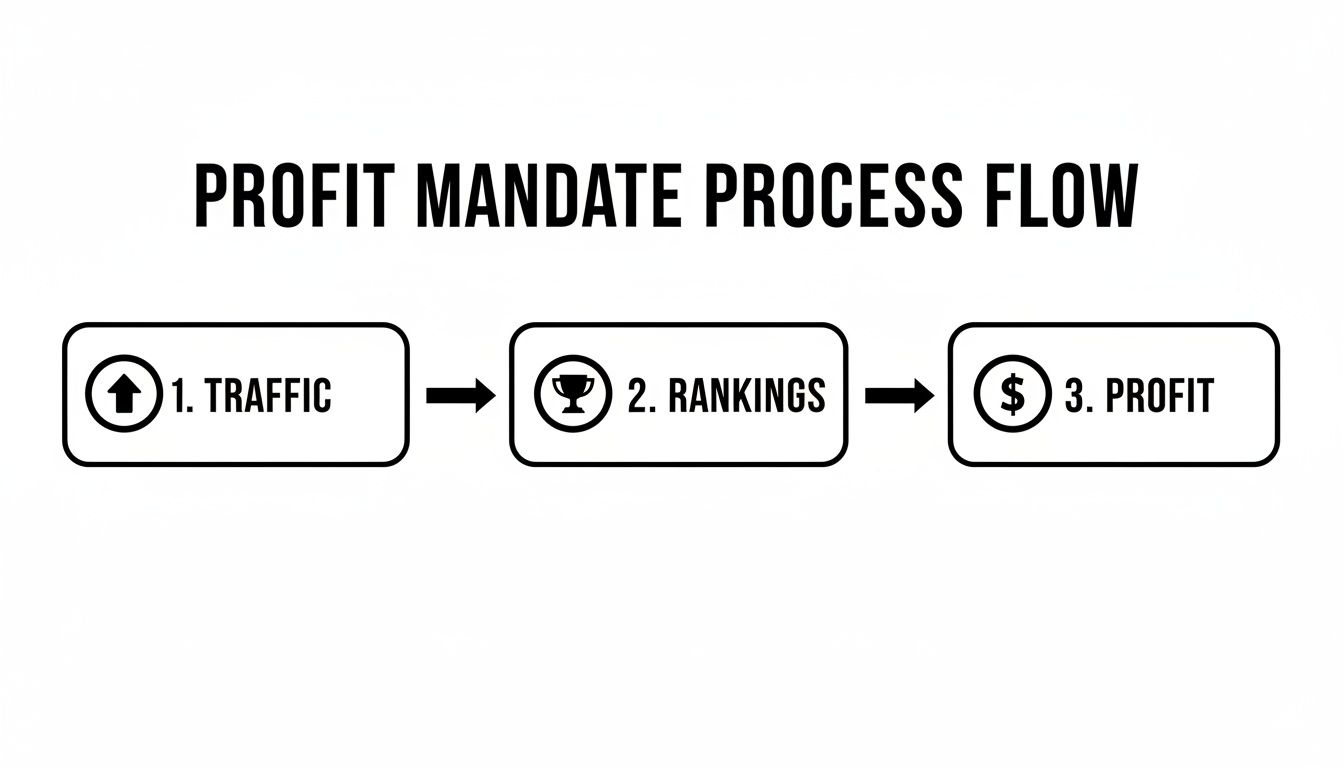
This flow makes it clear: SEO efforts that drive traffic and rankings only pay off when they lead to a conversion-focused listing—powered by strategic images—that actually makes you money.
Translating Insights Into Images
Let’s make this real. Imagine your research on a coffee grinder turns up top keywords like "quiet coffee grinder" and review complaints about inconsistent grinds and messy counters.
Your image strategy is now clear:
- Image 2 (Infographic): Show a decibel meter comparison or a simple graphic that screams "Whisper-Quiet Operation."
- Image 3 (Lifestyle): A shot of someone using the grinder in the early morning while their family is still asleep, visually proving the claim.
- Image 4 (Infographic): A side-by-side visual comparing your consistent grind to a competitor's chunky, uneven mess.
- Image 5 (Product in Use): A spotless countertop next to the grinder, visually proving its anti-static, no-mess feature.
This systematic approach turns your listing from a product gallery into a powerful visual sales pitch. New techniques like AI product photography for e-commerce are making it easier to create these targeted visuals.
Following this method ensures your investment in SEO actually pays off where it counts: the "Add to Cart" button.
Your Decision Checklist for Choosing an Amazon SEO Tool
Picking the right software is a high-stakes decision. Get it right, and your profits grow. Get it wrong, and you're burning cash on a subscription. Use this blunt checklist to audit your current stack or evaluate a new tool.
These questions force you to focus on ROI, not marketing hype.
The point of the best Amazon SEO tools is to give you accurate, profit-focused data that leads to smarter decisions—especially for your most powerful conversion asset: your images. Without that connection, you're just buying data for data's sake.
Key Evaluation Questions
Before you commit, demand clear answers. If a provider gets vague, walk away.
- Data Integrity: Where, exactly, does the tool get its keyword volume estimates? Does it lean on first-party Amazon Brand Analytics data, or just third-party metrics that might be wrong?
- Profit Focus: Can the tool show you true, SKU-level profitability? Can it factor in your COGS, PPC ad spend, and all Amazon fees to show which keywords are actually making you money?
- Workflow Efficiency: Will this tool genuinely save your team time? Does its interface map to your daily workflow, or will it create more busywork?
Ultimately, these tools are a means to an end. While general SEO studies show organic search drives traffic, how people discover products is fragmenting. You can find more analysis on how shopper search is evolving on sellerlabs.com.
The right tool doesn't just give you reports; it gives you leverage. It translates complex data into clear directives for your copy, your PPC campaigns, and—most importantly—the high-converting listing images that will close the sale.
This last point is non-negotiable. The data must drive your creative strategy.
If your tool’s insights don’t lead to better visual sales arguments in your images, you have the wrong tool. It’s that simple. By connecting your analytics to your visual strategy, you create research-driven images that boost conversion.
Burning Questions About Amazon SEO Tools
Even experienced sellers get stuck wondering if they have the right software. Let's cut through the noise with straight answers to the most common questions about choosing and using Amazon SEO tools.
All-in-One vs. Specialized Tools: Which Wins?
Neither. The "best" tool is the one that solves your biggest problem right now.
All-in-one suites are decent for broad oversight, especially for massive catalogs where a bird's-eye view is needed. But they're often a mile wide and an inch deep.
If your real challenge is identifying which keywords are actually profitable at a SKU level, a dedicated analytics tool will outperform a generalist suite every time. The key isn't the total number of features; it's the power of the one or two features you actually use.
How Critical is Amazon Brand Analytics Data?
It’s everything. Amazon Brand Analytics (ABA) is the ground truth.
Think of it this way: ABA is first-party data straight from Amazon. It tells you exactly how customers search. Any tool not using this data is guessing, using third-party estimates that can be wildly inaccurate.
When vetting a tool, check its data sources. If ABA isn’t prioritized, you can’t trust the numbers. It’s the clearest sign of a high-quality, accurate platform.
How Often Should I Re-Think My Tool Stack?
Conduct a hard review of your entire software stack annually. You should also perform a review anytime your business makes a major shift—like launching a new product line or expanding into a new marketplace.
The Amazon software landscape moves incredibly fast. New players and features appear constantly. What was best-in-class last year might be obsolete today.
Staying current ensures you aren't leaving money on the table. And if you’re trying to connect all that data to a visual strategy that actually converts, our team is always here to help.
Ready to turn your SEO data into high-converting listing images? ProductShots creates research-driven visuals designed to stop shoppers and drive sales. Learn more and place your order today.