Your Amazon Product Photography Is A Liability
Your standard product photos are costing you money. The “good enough,” clean, high-resolution shots you think are working are actively suppressing your click-through rates, tanking your conversions, and wasting ad spend.
This is where a true Amazon product photography service stops being a creative expense and becomes a critical, data-driven investment in sales velocity.
Why Your 'Good Enough' Photos Are Killing Your Sales
If you're an experienced operator, you're past the basics. You know a compliant hero image is non-negotiable and showing multiple angles is table stakes. But this is precisely where complacency becomes a conversion killer.
The single biggest mistake seasoned sellers make is treating their image block as a simple product gallery. It's not. It's your most powerful salesperson, and right now, it’s probably underperforming.
Your images have one job: to sell. They must do it instantly, on a crowded, mobile-first search results page where shoppers make snap judgments in under three seconds. If your photography merely shows the product, it has already failed.
The True Cost of Mediocre Imagery
Mediocre images aren't just an aesthetic problem; they create tangible business problems that hit your bottom line. Weak visuals are the root cause of countless seller headaches often misdiagnosed as issues with PPC, copy, or pricing.
These images are silently sabotaging your performance:
- Increased Customer Questions: Vague or incomplete images force buyers to hunt for information. This friction kills purchase momentum and floods your inbox with questions that should have been answered visually.
- Low On-Page Conversion Rates: When images fail to tackle unspoken objections or demonstrate clear value, shoppers hesitate. They abandon their carts, and your Unit Session Percentage tanks.
- High Return Rates: The primary driver for returns is a mismatch between expectation and reality. Photos that don't accurately set expectations for size, texture, or real-world use are a direct cause of costly returns.

From Liability to Asset
Your perspective must shift. Product photos are not a checkbox item on a launch list; they are the primary lever for improving performance across your entire Amazon business. Every other investment—from PPC campaigns to inventory management—is either amplified or nullified by the quality of your images.
Your image gallery is where the sale is won or lost. It must preemptively answer questions, dismantle objections, and build trust before a customer reads a single word of your copy.
A professional Amazon product photography service understands this. They don't just take pictures; they build a strategic visual argument designed to drive one action: Add to Cart. This strategic approach turns your images from a passive liability into an active, sales-generating asset, stopping the profit leak caused by preventable returns and hesitant buyers.
The Anatomy of a High-Conversion Amazon Image Stack
Your seven-image stack isn't a portfolio; it's a sales funnel. Each image has a specific job. Top sellers understand this. It’s not about showing different angles—it’s about systematically dismantling a buyer's objections and building desire before they even glance at your bullet points.
It starts with the hero image. Its only job is to win the click. Period. It must scream professionalism and instantly communicate what the product is, all while competing for attention on a noisy, mobile-first search page. Compliance with Amazon's terms—pure white background, product filling 85% of the frame—is just the price of entry. A winning hero image uses sharp lighting and a strategic angle to pop off the page and earn that click.
Deconstructing the Six Supporting Images
Once they click, your supporting images take over. This is where the real selling happens. Each of those six slots is an opportunity to crush a specific doubt, highlight a key benefit, or make an emotional connection. Wasting them on redundant product shots is a rookie mistake that bleeds conversions.
A professional amazon product photography service doesn't guess what these images should be. They build them based on research into your customer's pain points and purchase drivers.
The goal is to create a visual narrative that walks the shopper from "interesting" to "add to cart." These six images must answer every question and shut down every objection before it fully forms. For a deeper tactical breakdown, review a detailed Amazon Product Photography Guide for best practices.
Your Strategic Image Arsenal
Think of your six supporting images as specialized tools, each with a specific purpose. A high-conversion image stack almost always uses a mix of these:
- Lifestyle Images: Place the product in a real-world context. This helps shoppers visualize themselves using it. It's not just about showing scale; it's about selling the outcome the product delivers.
- Infographics & Callouts: Communicate critical information instantly. Use them to highlight key features, dimensions, or benefits that aren't immediately obvious. A well-designed infographic tells a story far faster than a paragraph of text, especially on a mobile screen.
- Comparison Charts: Go head-to-head with the competition. A simple chart comparing your product’s features against a generic or leading competitor eliminates doubt and positions your product as the obvious, superior choice. It’s an aggressive move that works.
- In-Use or "How-To" Shots: Show the product in action. This demonstrates its effectiveness, highlights ease of use, and manages customer expectations—a critical factor in reducing returns.
Your image gallery is your best salesperson. It must function like a preemptive problem-solving machine, systematically answering questions and building unwavering trust.
Data consistently shows that high-quality, research-driven images can boost conversion rates by up to 30%. When you deploy a full stack—a compliant hero plus six strategic secondary shots showing lifestyle context, in-use application, and clear infographic callouts—shopper hesitation evaporates. The 'Add to Cart' clicks follow.
A strategically built image stack doesn't just decorate your listing; it actively converts browsers into buyers. For more deep dives into image strategy, explore the other articles on our Amazon seller resource blog.
The Strategic Role of Each Amazon Listing Image
Most sellers see seven empty slots to fill. Top operators see a seven-step sales pitch. Each image has a specific job to move the customer closer to purchase. Understanding these roles is the difference between a listing that sits and a listing that sells.
| Image Slot | Image Type | Primary Goal |
|---|---|---|
| Image 1 | Hero Image | Win the Click. Stop the scroll on the search results page with a clean, professional shot. |
| Image 2 | Lifestyle/Context | Build Aspiration. Show the product in its ideal environment so buyers can visualize it in their own lives. |
| Image 3 | Infographic (Benefit 1) | Solve a Problem. Clearly highlight the single most important feature that solves a key customer pain point. |
| Image 4 | Infographic (Benefit 2) | Communicate Value. Showcase another major benefit or unique selling proposition with minimal text and clear visuals. |
| Image 5 | Comparison/How-To | Crush Objections. Compare against competitors or demonstrate ease of use to overcome purchase hesitation. |
| Image 6 | Feature Callout/Detail | Show Quality. Zoom in on materials, craftsmanship, or key components to build trust in the product's quality. |
| Image 7 | Social Proof/Trust | Reduce Risk. Display certifications, guarantees, package contents, or brand story to make the purchase feel safe. |
By architecting your image stack this way, you move from simply showing your product to strategically selling it. You are no longer uploading photos; you are building a visual argument that leads directly to a sale.
Building an Image Strategy from Customer Data
Any studio can take a picture. A true Amazon product photography service builds a visual sales argument.
The difference isn’t the camera—it’s the strategy. A real strategy isn’t built on creative whims. It's built from raw customer data.
The goal is to engineer an image stack where every photo preemptively answers a question, dismantles an objection, or highlights a critical reason to buy. You don’t guess what these are. You extract them directly from the source: your customers and your competitors' customers.
The visual hierarchy of your Amazon listing guides a shopper from curious to convinced.
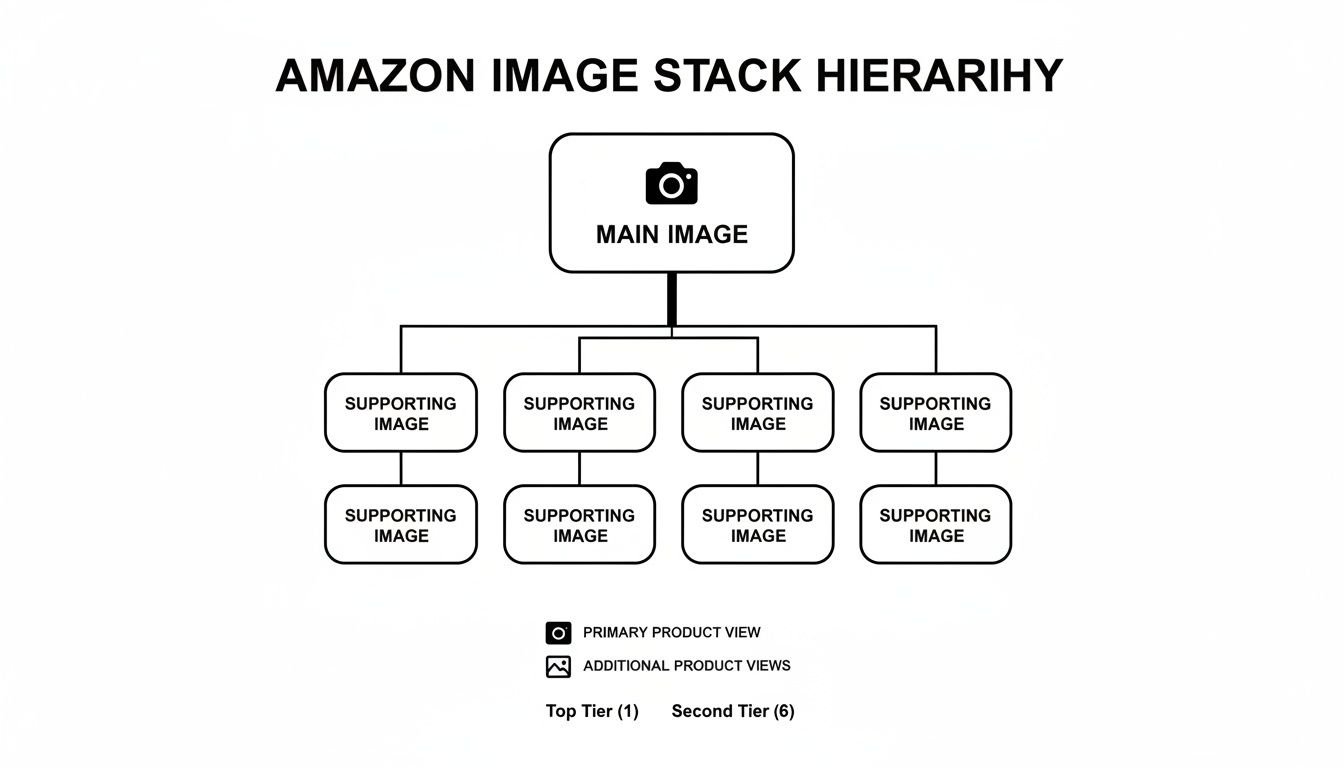
This structure is critical. The main image wins the click, but the six supporting images do the hard work of conversion.
Mine Customer Reviews for Intelligence
Your most valuable strategic insights are hiding in plain sight: in the 1-star, 2-star, and 5-star reviews of your product and your top competitors. This process, known as review mining, is non-negotiable for creating images that sell.
Ignore generic comments. You are hunting for recurring patterns and specific language. The objective is to identify the top 5-6 themes that fall into these buckets:
- Purchase Drivers: Why did happy customers really buy? Look for phrases like "I bought this because it was the only one that..." or "Finally, a product that does X." These are the core benefits you must visualize.
- Pain Points & Objections: Why were unhappy customers disappointed? Common themes are "it was smaller than I expected," "the material felt cheap," or "it was a nightmare to assemble." Each one is a problem your images must solve head-on.
- Recurring Questions: What are people repeatedly asking? If you see multiple questions about dimensions, compatibility, or what’s included, that's a clear signal that an infographic is mandatory.
Your negative reviews are a goldmine. They are a literal checklist of the objections your images must overcome to prevent returns and build buyer confidence.
Once you have this list, you have the foundation of your shot list. Each key insight translates directly into a photo concept. A complaint about size becomes an infographic with clear dimensions. A question about assembly becomes a simple step-by-step visual guide.
Analyze Competitor Visual Gaps
With your customer intelligence in hand, it's time for competitor analysis. The goal isn't to copy best-sellers. It's to pinpoint what they are failing to do. Where are the strategic gaps in their visual storytelling?
Open the listings for your top three competitors. Evaluate their images against the list of pain points and purchase drivers you just uncovered.
- Are they showing the product to scale effectively?
- Do they clearly address common concerns about material quality?
- Is there a confusing feature they fail to explain visually?
- Do their lifestyle images feel authentic or like cheap stock photos?
Every weakness you identify is an opportunity to dominate. If your competitor uses a confusing infographic, you create one that is crystal clear. If their lifestyle photos look fake, you invest in authentic shots that build a real connection. This isn't about having "better" photos; it's about having smarter photos that do a better job of selling.
By combining deep customer empathy from review mining with a tactical analysis of your competitors, you build a data-driven shot list. This transforms your Amazon product photography service from a content provider into a strategic partner, ensuring every image is a calculated tool for conversion.
How to Vet and Hire the Right Photography Service
Hiring an Amazon product photography service isn't like finding a local wedding photographer. You're not buying pretty pictures; you're investing in a sales tool.
The right partner is a conversion strategist who uses a camera. The wrong one is a creative who knows how to light a product but knows nothing about selling it on Amazon.
Choosing wrong is a costly mistake that extends beyond the initial invoice. You end up with images that don’t sell, forcing you to start over while your listing bleeds cash from low conversions and wasted ad spend. You need a specialist who lives and breathes the Amazon ecosystem.

Your vetting process must go deeper than scrolling through a portfolio and comparing prices. A great portfolio only proves they can operate a camera. It tells you nothing about their ability to construct a visual argument that compels shoppers to click "Add to Cart."
The Vendor Evaluation Checklist
To find a true partner, you must know what to look for and which red flags to avoid. This checklist will help you separate the Amazon conversion experts from generalist photographers.
| Evaluation Criterion | What to Look For | Red Flags |
|---|---|---|
| Strategic Process | They start with research: competitor analysis, review mining, and understanding your buyer's pain points. | They immediately ask for a shot list without doing their own homework. |
| Amazon Compliance | They have a clear process for staying on top of Amazon's ever-changing image requirements and TOS. | Vague answers about compliance or acting like it’s not a big deal. |
| Conversion Focus | They talk about conversion rates, buyer psychology, and visual hierarchy. | They focus on "brand aesthetic," "creativity," or their camera gear. |
| Revision Policy | A collaborative and clear revision process is built into their workflow. | Restrictive policies, extra fees for minor changes, or treating revisions as a hassle. |
| File Delivery | They deliver a complete package of perfectly optimized files (sRGB, correct dimensions, compressed). | They only provide high-res JPEGs, forcing you to handle optimization. |
| Portfolio & Case Studies | Their portfolio showcases clear, strategic Amazon image sets, ideally with performance data. | The portfolio is full of artistic product shots that would be flagged on Amazon. |
An expert's process should feel like a strategic partnership from the first conversation. They should be asking you tough questions about your product, customers, and business goals.
Questions That Separate the Pros from the Amateurs
When you connect with a potential service, your questions must be sharp. Their answers reveal everything. Forget about their gear. Focus on their process.
- "What’s your research process before you pick up the camera?" A pro will immediately talk about digging into competitor listings and customer reviews. An amateur will wait for you to provide the shot list.
- "How do you keep up with Amazon's image TOS?" Amazon’s rules change constantly. An expert will have a system for tracking updates to ensure your images are always compliant and never suppressed.
- "What does your revision process look like?" You want a partner who sees feedback as a crucial part of the process, not an annoyance. A vague policy is a huge red flag.
- "What file types and formats will I get?" The only correct answer involves files perfectly optimized for Amazon—correct dimensions, file size, and the sRGB color profile. Anything less creates more work for you.
A true Amazon photography service sells an outcome—higher conversions—not just a folder of JPEGs. Their entire process reflects that reality.
If a provider can't answer these questions confidently, they lack the specialized expertise to create images that perform. You can see what a truly conversion-focused philosophy looks like by learning more about the strategic approach of a dedicated Amazon agency.
Why Their Pricing Model Matters
How a service charges for their work reveals their priorities. You’ll typically encounter two models.
Per-Image Pricing: This common model incentivizes the studio to prioritize speed and volume over strategy. They make more money by cranking out shots quickly, which often leads to technically proficient but strategically weak images.
Package or Project-Based Pricing: This model is built for Amazon success. You pay a single price for a complete, 7-image stack. This structure aligns their goals with yours. It encourages investment in research and planning because success is tied to delivering a cohesive, high-performing image set—not just hitting a shot count.
For Amazon sellers, the project-based model is almost always the superior choice. It frames the engagement as a strategic partnership focused on a business outcome, not a simple transaction for a creative asset. This ensures every image works together to tell a story and drive sales.
How to Measure the ROI of Your New Images
Great images aren't an expense; they're an investment. Like any smart investment, you must measure its return.
Too many sellers upload new photos, see a sales bump, and move on. This is a mistake. You are leaving valuable data on the table.
To understand the power of strategic visuals, you must isolate their performance. This requires establishing a clear "before" picture of your listing's health and then tracking the "after" with precision. Your images are a sales tool. It's time to measure how well that tool works.
Guesswork has no place on Amazon. You need hard data, and Seller Central provides everything necessary to see the real impact.
Establishing Your Performance Baseline
Before you upload a single new image, you must snapshot your listing's current performance. This is your control. Without it, you’re flying blind.
Pull a report for the 30-day period immediately preceding the image update. You're looking for three non-negotiable Key Performance Indicators (KPIs):
- Click-Through Rate (CTR): Found in your Advertising Campaign Manager, this metric shows how well your main hero image convinces shoppers to click from a crowded search result.
- Unit Session Percentage (CVR): This is your conversion rate, located in "Business Reports" under "Detail Page Sales and Traffic." It measures how effectively your entire image stack turns visitors into buyers.
- Return Rate: Found in your "FBA Customer Returns" report, this number reveals if your images are setting correct expectations or causing buyer's remorse.
Log these numbers in a spreadsheet. This is your "before" benchmark. The mission is to beat it.
An investment in photography isn't just about a sales lift; it’s about improving the fundamental health of your listing. Measuring these core KPIs is the only way to see the full picture of your return.
Tracking the Post-Launch Impact
Once your new images are live, the clock starts. Wait 30 days to allow Amazon’s systems to gather meaningful data. Then, pull the exact same reports for the same three KPIs.
Place the "after" numbers next to your "before" data. The difference isn't magic—it's the direct, measurable ROI from your investment. To contextualize this process, it's worth understanding the fundamentals of how to measure marketing campaign success, because that's exactly what this is.
Looking only at top-line sales is a rookie mistake. A 5% increase in your conversion rate and a 15% decrease in returns can be far more profitable in the long run. Better images create a more efficient, healthier business.
Plugging the Profit Leak from Returns
Here’s the metric everyone forgets: your return rate. Every return is a profit leak, costing you money in fees, shipping, and often, unsellable inventory.
This is where strategic images pay for themselves. When your photos clearly show scale, texture, and how the product functions, you eliminate surprises. When you eliminate surprises, returns plummet—often by 20-30% or more.
Consider this scenario:
- Before: Your product has a 10% return rate. Each return costs you $8. For every 500 units sold, you lose $400.
- After: Your new, clearer images drop the rate to 7%. On those same 500 sales, you lose only $280.
That’s $120 straight back to your bottom line for every 500 units sold. Over a year, this saving alone can easily pay for the entire photography project. It proves that great images don't just make you money—they stop you from losing it.
Your Images Are a Business-Wide Force Multiplier
Viewing your product images as a standalone asset is a critical error. Strategic photography doesn't just improve your listing—it amplifies every other part of your Amazon business. It is a force multiplier.
Your visuals are the engine driving your PPC campaigns, organic rank, and even your ability to command a premium price. The connection is direct. Investing in a conversion-focused amazon product photography service is the single highest-leverage move you can make for profitable, long-term growth. It is the foundation upon which all other efforts succeed or fail.
Lower ACoS and More Efficient PPC
Your ad campaigns live and die on two metrics: Click-Through Rate (CTR) and Conversion Rate (CVR). Strategic images improve both.
A powerful hero image earns more clicks from the search results page, instantly boosting your ad's CTR. Once a shopper lands on your listing, a smart image stack converts that expensive click into a sale. This one-two punch makes your ad spend radically more efficient.
A higher conversion rate means you generate more sales from the same ad budget, which directly lowers your Advertising Cost of Sale (ACoS). You stop merely buying traffic and start buying profitable sales.
Sellers try to fix a high ACoS by endlessly tweaking bids and keywords. The real problem is often a listing that doesn't convert, and the fastest fix is better images.
The Direct Line to Organic Ranking
Amazon’s A10 algorithm is obsessed with one thing: sales velocity. That velocity is driven by a high conversion rate.
When a high percentage of visitors to your page buy your product, it sends a powerful signal to Amazon that your listing is a great match for customer searches. When your new, research-driven images boost your CVR, you are directly feeding the ranking algorithm exactly what it wants.
This improved CVR leads to better organic keyword rankings, driving more high-intent, free traffic to your listing and creating a powerful, self-reinforcing growth loop.
Command Higher Prices and Build Perceived Value
Finally, premium, trust-building images give you pricing power.
Generic, low-effort photos signal "cheap commodity." They force you to compete on price, a race to the bottom.
In contrast, a polished and strategic set of images communicates quality and elevates the perceived value of your product. This allows you to command a higher price and protect your margins from cut-throat competitors. When customers trust what they see, they become far less price-sensitive.
To see how a professional service can build this visual authority for your brand, you can explore our straightforward process and place an order. Strategic images transform your product into a premium brand—not just another option in a crowded search result.
Frequently Asked Questions
Experienced sellers have a few key questions before committing to a professional service. Here are the direct answers.
How Long Does a Typical Project Take?
This is not a one-day photoshoot. A true Amazon product photography service engineers images that sell, which requires a structured process.
- Phase 1: Research & Strategy (1-2 business days): We analyze competitors and customer reviews to build a data-driven shot list that targets buyer motivations and objections.
- Phase 2: Logistics & Shooting (2-4 business days): This covers product transit time to the studio and the photoshoot itself.
- Phase 3: Post-Production & Delivery (2-3 business days): This includes editing, retouching, infographic design, and optimizing final files for Amazon.
Realistically, plan for one to two weeks from start to finish. Rushing the process guarantees mediocre images that underperform.
How Does Product Shipping and Handling Work?
Logistics are straightforward. You are responsible for shipping your product to the studio. A professional service will provide a clear shipping address and instructions upon project kickoff.
Sending two units is standard practice. This provides a backup in case of shipping damage and allows the studio to shoot multiple setups simultaneously. After the project, the service will either ship the products back to you (at your expense) or dispose of them per your instructions.
Can I Repurpose These Images for Other Channels?
This depends entirely on the provider's licensing agreement. A reputable service focused on e-commerce will provide a broad commercial license, allowing you to use the images on your own website, social media, or other marketing channels.
However, you must confirm this upfront. Never assume unlimited rights. Also, remember that images designed for Amazon's mobile-first layout may need cropping or minor adjustments to perform optimally on platforms like Instagram or your own direct-to-consumer site.
What Happens If the Final Images Miss the Mark?
This is precisely why a detailed creative brief and a clear revision policy are non-negotiable. If the final images are not what you expected, the first step is to reference the agreed-upon brief. Did the service miss a specific requirement?
A professional service will have a clear revision process outlined in their terms. This typically includes one or two rounds of reasonable edits, such as tweaking a color or changing text on an infographic. A complete reshoot is rare and generally only occurs if the service made a major error. You can review an example of a structured refund policy designed for creative projects.
Ready to transform your listing with images that sell? ProductShots creates a complete, research-driven image stack designed to boost your conversion rate. For a one-time fee, get seven strategic images that address buyer pain points and make your product the obvious choice. Learn more and get started today.