How to Hire the Right Amazon PPC Agency
An Amazon PPC agency isn't just a marketing partner; for established sellers, it's a strategic lever for scaling market share. They take over your paid ad campaigns on Amazon, handling everything from keyword research and bid management to deep performance analysis. Their sole function is to drive profitable sales and extract maximum value from your ad spend.
Why Your Brand Needs a Specialized Amazon PPC Agency
Most sellers start by managing Amazon PPC in-house. It seems like a smart way to save money. But as your brand scales, that "cost-saving" measure quickly becomes a liability. The platform's complexity grows, ad costs (CPCs) climb relentlessly, and the time suck begins to eat into your margins.
This is the inflection point where hiring a dedicated Amazon PPC agency stops being a cost and becomes a critical investment.
The real value isn't just in "running ads." It’s about leveraging a level of expertise that your in-house person, who’s probably juggling ten other jobs, can never hope to match.
Escaping the In-House Management Trap
A true expert agency goes far beyond basic campaign tweaks. They’re focused on what actually drives growth. They have a massive advantage: institutional knowledge built from managing dozens of accounts across different categories. This gives them insights into what’s really working right now.
- Algorithmic Mastery: They understand the nuances of Amazon's A9 algorithm. They know how ad performance bleeds into organic ranking, creating a powerful flywheel effect that most sellers miss.
- Advanced Tooling: Agencies invest in sophisticated software for bid automation, keyword harvesting, and competitor analysis. This tech is usually too expensive or complicated for a single brand to justify.
- Dedicated Focus: Their team lives and breathes Amazon ads. They’re the first to know about new ad formats, beta programs, and platform updates, giving your brand a crucial first-mover advantage.
This singular focus is everything. While you’re busy with sourcing, inventory, and new product development, your agency is 100% focused on one thing: turning your ad spend into profitable revenue. They don't just babysit campaigns; they dissect performance data to find hidden opportunities and cut waste with surgical precision.
The True Cost of Inefficient PPC
Wasted ad spend is the obvious problem with poor PPC management. The hidden costs are far worse.
Inefficient campaigns lead to lower conversion rates. This signals to Amazon that your product is less relevant, which tanks your organic rank over time. You end up in a downward spiral, forced to spend more and more on ads just to stay visible. A huge part of a winning PPC strategy is using proven persuasive advertising techniques to not just get clicks, but to actually convert them into sales.
An agency’s main job is to reverse this spiral. By improving ad efficiency, they boost sales velocity and conversion rates. This tells Amazon your product deserves a better organic spot. This synergy between paid ads and organic rank is where real, scalable growth happens.
Ultimately, hiring a top-tier Amazon PPC agency is about repositioning your ad budget. It ceases to be an expense; it becomes an investment in market domination. It’s a strategic choice to trade the false economy of DIY management for the expertise required to win in a hyper-competitive space.
Decoding Agency Pricing Models
Figuring out an Amazon PPC agency's pricing model isn't just a box to check—it's everything. The way an agency charges reveals their core incentives, which directly impacts their strategy and, ultimately, your bottom line.
Get this wrong, and you could end up with a partner motivated to simply spend your money instead of actually growing your profit.
An agency’s proposal is more than a price tag; it's a window into their operational philosophy. Don't get trapped by a model that misaligns their success with yours. Let's break down the common structures so you can dissect any proposal with confidence.
Percentage of Ad Spend
This is the most common model. The agency takes a cut of your total monthly ad spend, usually between 8% and 20%. The logic seems simple: as your ad budget grows, so does their fee.
On paper, this appears to align interests. For the agency to make more money, you need to spend more, which should come from successful scaling, right?
The problem is the inherent conflict of interest. A lazy or unsophisticated agency can easily boost their own fee by simply inflating your ad spend—even if it means driving unprofitable sales and wrecking your ACoS. This model is only viable if you hold the agency accountable to profitability metrics like TACoS (Total Advertising Cost of Sale), not just raw spend.
Flat Monthly Retainer
A flat retainer provides predictability. You pay a fixed fee each month, regardless of your ad spend. This fee is typically based on the scope of work, such as the number of ASINs under management or the overall complexity of your account.
The primary benefit is budget clarity. You know exactly what you'll owe every month, making financial planning straightforward. This structure is often a great fit for brands with stable ad budgets or those who need to maintain tight cost controls.
The downside? Complacency. Since the agency's fee isn't tied to growth, their motivation to aggressively scale your campaigns or hunt for new opportunities may diminish. A great agency will set clear performance goals to combat this, but a mediocre one might just coast and maintain the status quo.
Key Takeaway: A flat retainer removes the incentive to mindlessly crank up ad spend, but it puts the burden on you to set and enforce clear performance KPIs. Without them, you're paying for activity, not results.
Performance-Based and Hybrid Models
Performance-based models link the agency's fee directly to your results, often as a percentage of the revenue or profit generated from ads. This is the ultimate alignment of interests: the agency only makes serious money when you do. It’s an attractive model because it minimizes your upfront risk.
However, pure performance deals are rare. They often come with much higher percentage fees to compensate the agency for taking on all the risk.
What you'll encounter more frequently are hybrid models. These usually combine a lower flat retainer with a performance bonus. For instance, an agency might charge a base fee plus an extra percentage of revenue once you hit a specific ACoS or sales target. This provides the agency with stable income while heavily incentivizing them to crush ambitious growth goals. For most growth-focused brands, this balanced approach is the sweet spot.
Here’s a quick breakdown of how these models stack up.
Amazon PPC Agency Pricing Model Comparison
| Pricing Model | Best For | Pros | Cons |
|---|---|---|---|
| Percentage of Ad Spend | Brands with large, rapidly scaling budgets and strong internal oversight. | Simple to calculate; incentivizes agency to scale spend. | Creates a conflict of interest; can encourage wasteful spending. |
| Flat Monthly Retainer | Brands needing predictable costs or with stable, mature ad accounts. | Budget certainty; no incentive to inflate ad spend. | Can lead to agency complacency; not directly tied to growth. |
| Performance-Based | Aggressive growth brands confident in their product's conversion potential. | True partnership; agency is 100% motivated by your success. | Rare to find; usually involves a higher percentage cut of revenue/profit. |
| Hybrid Model | Most growth-focused brands looking for a balanced partnership. | Aligns incentives for growth while providing agency stability. | Can be more complex to track and calculate payments. |
Choosing the right model is about finding the structure that best supports your specific business goals, whether that's predictable costs, aggressive growth, or a mix of both.
Regardless of the pricing model, a skilled agency brings a few core benefits to the table.
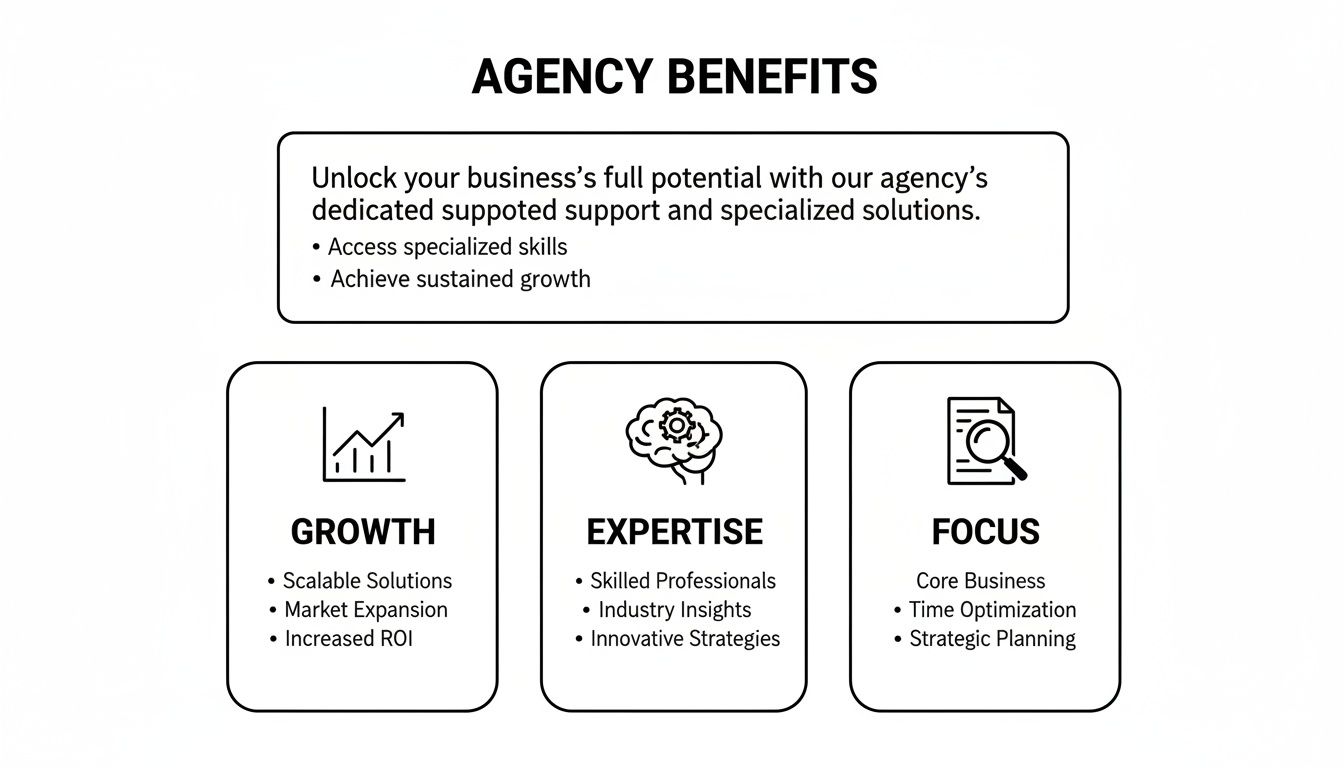
This boils down to how expert management leads to scalable growth and frees you up to focus on the parts of the business only you can run.
The Vetting Questions That Expose True Expertise

The discovery call is your opportunity to separate the real experts from the glorified campaign managers. Most sellers make the mistake of sitting back and letting the agency run through a polished sales deck.
Don't do that.
You need to take charge and ask pointed questions that cut through the marketing fluff. Forget useless queries like "What results can you get me?" They're easy to deflect. Instead, you need a playbook that forces them to talk strategy, not just show off their best case studies.
A great Amazon PPC agency will lean into this kind of scrutiny. A mediocre one will stumble. This isn't about being difficult; it's about conducting proper due diligence. Their answers will tell you if they think like a business owner focused on profit or just an operator chasing a low ACoS.
Peeling Back Their Strategy and Structure
First, dig into how they build and manage campaigns. This is a massive indicator of their real-world expertise. Vague answers here are a huge red flag.
Ask them this directly: "Walk me through your typical campaign structure for a new product versus an established one."
A top-tier agency won't have a canned response. They’ll discuss segmenting campaigns for research, performance, and brand defense. They should be able to explain how they use different match types to control traffic and continuously harvest new, profitable keywords.
Here are the follow-ups to really pin them down:
- Keyword Harvesting: "What’s your exact process for moving a search term from an auto campaign into a manual one? What specific criteria does it need to hit?"
- Match Type Philosophy: "How do you decide when to use broad, phrase, and exact match? Do you separate them into different campaigns or ad groups?"
- Negative Keywords: "Describe your strategy for using negative keywords. How often do you review and update those lists?"
You're listening for a clear, repeatable system. If it sounds like they’re making it up as they go, they probably are. This is how you determine if they have a proven methodology or just a subscription to a fancy software tool.
Uncovering Their Logic on Bids and Optimization
Bid management is where an agency either makes you money or sets it on fire. An agency that can’t clearly explain its bidding philosophy is a massive liability, especially as ad costs keep climbing.
With average CPCs jumping 15.5% year-over-year to $1.12, smart bidding is non-negotiable. It's how top performers achieve a 4.2x ROAS and 127% revenue growth. This pressure is why 55% of companies now outsource their PPC, as detailed in reports about navigating rising PPC costs on ecombrainly.com.
Ask this critical question: "What is your philosophy on bid management? Do you rely on automated rules, Amazon's dynamic bidding, or manual adjustments?"
There isn’t one "right" answer, but a strong one will almost always be a hybrid approach. More importantly, they must be able to explain why they choose a certain method for a specific campaign goal.
An expert agency knows bidding isn't just about hitting an ACoS target. It's about bidding for placement, for organic rank, and for market share. They should be able to explain how their bidding strategy changes based on a product's lifecycle and your overall business goals.
Gauging Their Grasp of Modern Ad Types
Amazon’s ad platform is constantly evolving. An agency stuck in 2020, relying only on Sponsored Products, will leave a ton of opportunity on the table. You need a partner who is fluent in the entire ad ecosystem.
Probe their modern expertise with this: "How do you integrate Sponsored Brands, Sponsored Display, and Amazon DSP into a holistic strategy? Give me a specific example."
Listen for answers that show they understand the unique role of each ad type:
- Sponsored Brands for top-of-funnel awareness and defending your brand space.
- Sponsored Display for retargeting, cross-selling, and conquering competitor product pages.
- Amazon DSP for reaching shoppers both on and off Amazon to drive new-to-brand customers.
If they can't provide a clear example of how these work together, they lack the strategic vision to truly scale your brand.
Demanding Metrics That Actually Matter
Finally, find out how they measure success. Any agency can send you a dashboard with a pretty ACoS graph. A real partner knows ACoS is just one piece of a much bigger puzzle.
Ask this final, crucial question: "Beyond ACoS and ad spend, what are the top 3 KPIs you report on, and why do they matter for my business's profitability?"
Their answer must include metrics that reflect total business health, not just ad performance in a vacuum. Look for these:
- Total Advertising Cost of Sale (TACoS): This shows how ad spend impacts total revenue (paid and organic). A falling TACoS means your ads are successfully lifting your organic rank—that’s the holy grail.
- New-to-Brand Metrics: This KPI shows if your ads are acquiring new customers or just converting existing ones. You can't grow without acquiring new buyers.
- Share of Voice (Impression Share): This tells you how visible your brand is for key search terms versus your competitors. It's a direct measure of market dominance.
An agency that leads with these metrics gets the bigger picture. They aren't just managing your ads; they're helping you build a defensible brand on Amazon. These questions are your filter—use them to find a partner who can deliver real, sustainable growth.
Critical Red Flags of a Bad Agency Partnership

Hiring the wrong agency is far more damaging than just running bad PPC ads yourself. A bad partner doesn't just waste your ad spend—they actively erode your organic rank, torch your cash flow, and can set your brand back months.
Spotting a dud early isn't about a gut feeling. It's about recognizing specific, predictable warning signs. This is your risk-mitigation checklist to sidestep partnerships that promise the world but only deliver invoices.
The ACoS Guarantee and Other Empty Promises
Any agency guaranteeing a specific ACoS target is either dangerously inexperienced or flat-out dishonest. The Amazon ad auction is a volatile, live marketplace. Competitor moves, seasonality, and algorithm shifts make fixed outcomes impossible.
This "guarantee" is usually a bait-and-switch tactic. An agency can easily hit a low ACoS by only bidding on your branded search terms or hyper-specific, long-tail keywords. This looks great on paper, but it drives almost zero new customer growth.
They’ll celebrate a 15% ACoS while your total sales flatline. Real growth is about balancing profitability and scale, not chasing a vanity metric that starves your business of new eyeballs.
Vague Reporting and a Lack of Transparency
If an agency's reporting feels like a summary instead of a deep-dive analysis, run. A monthly PDF with top-level stats like spend, sales, and ACoS isn't strategic management. It’s glorified data entry.
A real partner delivers reporting that tells a story. They should break down performance at the campaign, ad group, and even keyword level. You need to understand the "why" behind the numbers, not just the "what."
You should be getting clear answers to these questions:
- What did we test this month? This could be anything from new ad copy and bidding strategies to fresh campaign structures.
- What did we learn from those tests? Win or lose, every experiment should produce a real, actionable insight.
- What's the plan for next month based on this data? Their strategy should be a direct response to the last 30 days of performance.
An agency that can't provide this level of detail is just babysitting your account. They aren't actively managing it for growth.
Over-Reliance on Software Without Strategy
Plenty of agencies use powerful PPC software to automate bidding and keyword research. These tools are fantastic, but they are never a substitute for a human-led strategy.
A major red flag is when an agency pitches their "proprietary software" as their main value proposition. The software is just a tool; the real value is the strategist pulling the levers. An algorithm can't understand your inventory levels, your profit margins, or the competitive landscape.
The most dangerous version of this is the "set it and forget it" agency. They plug your account into their software, set a target ACoS, and let the algorithm run wild. This hands-off approach almost always leads to massive ad waste and missed opportunities because no one is providing the critical oversight needed. A top-tier Amazon PPC agency uses software to execute a strategy, not to replace it.
One-Size-Fits-All Strategies
If an agency’s pitch sounds like it could apply to any product in any category, they don't have a real strategy. Every brand, product, and market is unique.
A competent agency starts by digging into your business with sharp questions:
- What are your actual profit margins?
- What are your inventory constraints and lead times?
- Who are your top three competitors, and what are they doing?
- What's the #1 business goal right now—profitability, launching a product, or grabbing market share?
Their proposed strategy should be a direct reflection of your specific situation. An agency pushing a generic "proven system" without understanding your business first is just selling a template. This approach ignores the very nuances that determine success on Amazon and is a dead giveaway you’re talking to a vendor, not a partner.
How to Onboard and Manage Your New Agency for Success
Signing the contract is the easy part. The real work—building a profitable partnership with an Amazon PPC agency—kicks off with a fast and focused onboarding.
A lazy start kills momentum before it even begins. You can’t afford to let your new agency just "figure things out" for the first month. Success means arming them with the right data and strategic direction from day one. In return, you demand a clear, actionable plan.
Equipping Your Agency for Immediate Impact
Your agency is only as good as the information you provide. A random data dump is useless. They need focused, strategic assets that shorten their learning curve and empower them to make smart decisions, fast.
Your onboarding package must include:
- Complete Historical Data Access: Grant them full, unrestricted access to your advertising console and any relevant past performance reports. Don't hide the ugly parts.
- Brand Guidelines and Voice: Provide a concise brand guide. They need to get inside your customer's head, understand your brand voice, and know your unique selling propositions to write ad copy that converts.
- Inventory Forecasts and Margins: Share your inventory projections and product-level profit margins. An agency flying blind on inventory or profitability will inevitably blow your ad budget on products that are about to stock out or have paper-thin margins.
- Top Performing ASINs and Strategic Goals: Clearly define your "hero" products and your main objective. Are you trying to maximize profit, liquidate inventory, launch a new product, or aggressively steal market share?
This isn't about micromanaging. It's about setting the strategic guardrails so their day-to-day work aligns perfectly with your business's financial reality.
Demanding a Strategic 30-60-90 Day Plan
In exchange for this data, you must get a detailed 30-60-90 day plan. This is a non-negotiable deliverable that should be locked in within the first week. It’s your roadmap for accountability.
A vague plan that just says "optimize campaigns" is a massive red flag. A professional plan will have concrete, measurable milestones.
- First 30 Days: Audit and Foundational Restructuring. This phase is all about a deep-dive audit of your existing account. They should be establishing a logical campaign structure, implementing robust negative keyword lists, and setting up initial performance benchmarks.
- Next 30 Days: Testing and Expansion. Here, the agency should be aggressively testing new keywords, ad copy, and bidding strategies. This is also when they should start expanding into other ad types like Sponsored Brands and Sponsored Display based on initial data.
- Final 30 Days: Scaling and Optimization. By this point, the agency should be pouring fuel on the fire, scaling the winning campaigns and strategies identified in the previous phase. The focus shifts from broad testing to ruthlessly optimizing for your core business goals.
This plan becomes your primary management tool. It transforms your weekly check-in calls from subjective "how's it going?" chats into objective reviews of progress against agreed-upon deliverables.
Moving Beyond ACoS to Metrics That Matter
The single biggest mistake sellers make is managing their agency based only on Advertising Cost of Sale (ACoS). ACoS is a tactical efficiency metric; it’s not a true measure of business growth. A competent Amazon PPC agency will welcome a move toward more meaningful KPIs.
Your weekly and monthly performance reviews must be anchored to these metrics:
- Total Advertising Cost of Sale (TACoS): This is your north star. It measures your ad spend against your total sales (both paid and organic). A declining TACoS is proof that your ads are creating a flywheel effect, boosting your organic rank and building long-term brand equity.
- Organic Rank Improvement for Target Keywords: Track the organic search position for your top 5-10 most important keywords. Successful PPC should directly improve your organic visibility, reducing your long-term reliance on ads.
- New-to-Brand Customer Acquisition: Use Amazon's data to see if your campaigns are actually acquiring new customers or just recapturing existing ones. Real growth depends on acquisition.
The explosion of Amazon PPC agencies is a direct result of the market's insane growth. With Amazon projected to hit nearly $69.3 billion in ad revenue, the stakes are higher than ever, and third-party sellers are driving most of this action. You can read more about the growth of the Amazon advertising ecosystem on salesduo.com. This competitive pressure makes it critical to manage your agency with metrics that reflect true business health, ensuring your partnership drives bottom-line results, not just pretty ad reports.
Your Lingering Questions About Hiring an Amazon PPC Agency, Answered
Even after doing your homework, a few specific questions always pop up. Here are the straight, no-fluff answers to the common hang-ups sellers have before hiring an agency.
How Long Until I Actually See Results?
Forget about magic in the first month. Any agency promising an overnight turnaround is selling a fantasy. The first 30 days are dedicated to auditing your account, gutting what’s not working, and building a new foundation.
You should expect to see tangible, data-backed improvements within 90 days. By the end of that first quarter, a good agency will have enough data to show clear progress on your most important metrics, whether that's a lower TACoS or better organic rank for your money-making keywords.
What’s the Right Way to Grant Account Access?
Whatever you do, don't hand over your main login details. The only secure, professional way to do this is by granting secondary user access through Seller Central.
You simply add them as a new user and customize their permissions. This gives the agency everything they need to manage the advertising console without ever touching the sensitive parts of your business. Any professional agency knows this is standard procedure and will guide you through it.
Key Takeaway: If an agency asks for your root login and password, run. It’s a massive red flag that screams amateur hour and shows a total disregard for basic Amazon security.
What Kind of Contracts Should I Expect?
Most reputable agencies will start with an initial commitment period, usually between three to six months. They need this time to implement their strategy and gather enough performance data to prove it’s working.
After that initial term, the agreement typically rolls into a month-to-month plan with a 30-day cancellation notice. Be wary of anyone trying to lock you into a 12+ month contract from the start. It kills your flexibility if things go south.
For a deeper dive on what to look for, you might find more helpful info on hiring Amazon PPC management services.
How Do I Measure the Real ROI of an Agency?
Thinking about ROI purely in terms of ACoS is a rookie mistake. The real value of an elite Amazon PPC agency is how it impacts your entire business, not just your ad campaigns.
The metric that tells the real story is Total Advertising Cost of Sale (TACoS). It shows you the relationship between ad spend and your total revenue. When TACoS goes down, it’s proof your ads are successfully lifting your organic sales—and that’s the holy grail.
The right partner can have a massive impact on your bottom line. We're talking about elite management firms that have optimized over $1.6 billion in ad spend to generate $6 billion in sales for their clients, boosting profits by an average of 51%. That's the kind of leverage a true strategic partner brings to the table.
Finally, don't forget to factor in the value of your own time. Outsourcing PPC frees you up to focus on product sourcing, brand building, and the big-picture strategy only you can execute. That reclaimed time is a huge, often overlooked, part of an agency's true value.
At ProductShots, we create research-driven Amazon listing images designed to improve the performance of your PPC campaigns and boost your conversion rates. Stop guessing and start converting with a complete, strategically designed image set for just $400. Get your conversion-focused Amazon images today.