
Your Images Are The Single Biggest Lever For Amazon Growth. Are You Treating Them That Way?
Your product title and keywords get you found, but your images get you paid. This isn't a theory; it's the fundamental reality of selling on Amazon. If you treat your listing images as a design task instead of a conversion engineering project, you are actively leaving money on the table.
Elite Amazon listing optimization services don’t sell "pretty photos." They deliver a research-backed visual sales argument, engineered to increase conversion rate, lower ACoS, and drive organic rank. Your image stack is the single most powerful lever you can pull to impact sales velocity.
What Elite Amazon Listing Optimization Services Actually Deliver
Let's cut right to it. Keywords get your product found, but your images get it sold.
So many sellers get this wrong. They see listing optimization as a simple checklist: get a good title, sprinkle in some keywords, and upload decent photos. This is a fundamental misunderstanding of how the Amazon game is won. Your copy sells second; your images sell first.
High-value listing optimization services operate on a completely different level. They treat your listing—and especially your images—as a silent, 24/7 salesperson. The goal isn’t just to show the product. It's to systematically walk a customer from mild curiosity to a confident purchase, often before they even glance at the bullet points.
The Shift from Design to Conversion Engineering
An elite service doesn’t start with a camera. It starts with research.
The entire process is built on a deep-dive analysis to get inside the customer’s head. This is the strategic foundation and it includes:
- Competitor Analysis: Systematically finding the visual weaknesses in top competitor listings that you can exploit.
- Customer Review Mining: Pulling out the most common questions, frustrations, and desired benefits directly from the customer’s own words.
- Search Intent Analysis: Figuring out the why behind a search so your visual messaging speaks directly to the shopper’s core problem.
You’re not just buying photography or graphic design. You're investing in a data-driven system built to increase your conversion rate. The images are just the final, tangible output of a much deeper strategic process.
The core principle is simple: every image must have a job. It has to answer a question, crush an objection, build trust, or create an emotional connection. If it doesn't, it's just wasting valuable digital real estate.
The Force Multiplier Effect
Getting your images right has a powerful ripple effect across your entire Amazon business.
A well-engineered image stack directly improves your PPC efficiency by boosting ad conversion, which naturally lowers your ACoS. It increases your sales velocity, which is a major signal to Amazon’s A10 algorithm that boosts your organic ranking. A comprehensive playbook for increasing Amazon sales and mastering listing optimization breaks down how these pieces all connect.
The impact is real and often dramatic. One seller we worked with upgraded their yoga mat listing with nine strategic images, including specific lifestyle shots and benefit-driven infographics. The result? A 156% increase in their conversion rate. This visual overhaul pushed the product from page 3 to page 1 for its main keywords in just 60 days.
That’s the true deliverable of elite optimization—not just better pictures, but better business results.
Anatomy of a High-Conversion Amazon Image Stack
Think of your Amazon listing as a silent salesperson. If that’s the case, your image stack is its entire sales pitch.
Most sellers treat this space like a photo gallery. This is a massive mistake. Each of your seven image slots is a strategic asset with a very specific job, engineered to walk a buyer from casual curiosity to a confident "Add to Cart."
Thinking beyond a simple hero shot isn’t optional anymore. Top-tier Amazon listing optimization services don't just design pretty pictures; they engineer a visual argument. The whole process starts with deep-dive research—mining competitor weaknesses and customer reviews to figure out the exact questions, objections, and desires that drive someone to buy in your category.
The goal here is a seamless flow. Each image should build on the last, systematically knocking down purchase barriers before a customer even thinks to read your bullet points.
Deconstructing the Seven Image Slots
Your image stack isn't just a handful of photos. It's a structured narrative. Each slot has a distinct psychological purpose, hitting different stages of the buyer’s decision-making process. Wasting a slot on a redundant angle is like a salesperson going quiet right in the middle of their pitch.
To get this right, you need to understand the strategic purpose behind each image slot. The best-performing listings follow a proven formula that leaves nothing to chance.
| Image Slot | Image Type | Strategic Purpose |
|---|---|---|
| 1 | Hero | Earn the click. Must be a crystal-clear shot on a pure white background. Its only job is to stop the scroll in search results. |
| 2 | Lifestyle/Context | Build an emotional bridge. Show the product being used. Let the customer visualize it in their own life and feel the benefit. |
| 3 | Benefit-Driven Infographic | Solve the core problem. This isn't a feature list. Use bold visuals to show the single biggest benefit that solves their main pain point. |
| 4 | Feature Callout Infographic | Build logical trust. Now, highlight 2-3 key features that support the main benefit. This shows how your product delivers on its promise. |
| 5 | Objection Handling | Overcome hesitation. Address the most common doubt found in reviews (e.g., "is it durable?", "is it hard to assemble?"). Show, don't just tell. |
| 6 | Comparison Chart | Keep them on your page. Compare your product to a generic alternative. Make your offer the obvious, superior choice and stop them from clicking away. |
| 7 | Brand Story / What's in the Box | Solidify the purchase. Show everything they get, highlight a guarantee, or connect back to your brand. This final image closes the loop and reduces risk. |
This table outlines the playbook that separates amateur listings from professional selling machines. Each image has a specific job in moving the customer closer to purchase.
A classic mistake is filling slots 2 through 7 with slightly different angles of the product. This tells the customer absolutely nothing new and wastes the chance to build a compelling case for buying, which directly tanks your conversion rate.
This structured approach transforms your listing from a passive product display into an active selling tool. For more examples and deep dives into visual strategy, you can explore additional insights on our blog. This framework is the foundation that top-tier services use to turn clicks into paying customers.
How to Vet and Select the Right Optimization Partner
Choosing the wrong partner for your Amazon listing is a costly mistake. It’s a time-suck that can set your brand back months, burning cash on images that don't convert.
The problem is, not all "agencies" are created equal. You're not looking for a generic design firm that makes pretty pictures. You need a strategic partner who gets deep into buyer psychology and knows how to build assets that sell.
Making a smart, ROI-driven decision means you have to vet them tactically. You need to get past the surface-level portfolio and dig into the strategic thinking—or the lack of it—behind their work. The goal is simple: find a true optimization service that builds conversion assets, not just decorative fluff.
The Litmus Test: How to Really Review a Portfolio
A portfolio isn't just a gallery of pretty work. It's evidence of a thought process. When you're looking at a potential partner’s case studies or "before and after" examples, ignore how slick they look at first.
Instead, look for the strategy.
- The "Before": Is the "before" shot a genuinely weak listing they were hired to fix? Or is it just an older version of their own work, staged to look like a dramatic improvement? An honest portfolio shows them solving real-world problems.
- The "After": Can you reverse-engineer their logic from the final images? Every single image should have a clear job. One image crushes an objection, another highlights a key benefit, and another builds an emotional connection. If it’s just a random assortment of nice photos, they don’t get it.
- The "Why": Do their case studies explain why they made certain choices? A top-tier partner will tell you their reasoning (e.g., "Review mining showed customers were confused about assembly, so we created an infographic to walk them through it"). A weak one will just say, "we improved the images."
If their portfolio is all sizzle and no steak—just a collection of nice-looking photos without a clear, conversion-focused story—that's a massive red flag. It tells you they’re a design shop, not a sales machine.
Critical Questions That Reveal True Expertise
Your first few calls aren't friendly chats. They're an interrogation. Your mission is to expose their methodology. Price means nothing if their process is broken.
Use these direct questions to cut right through the marketing fluff and see if they actually know what they're doing.
The visual assets they create should follow a clear hierarchy, designed to guide a shopper from click to conversion.
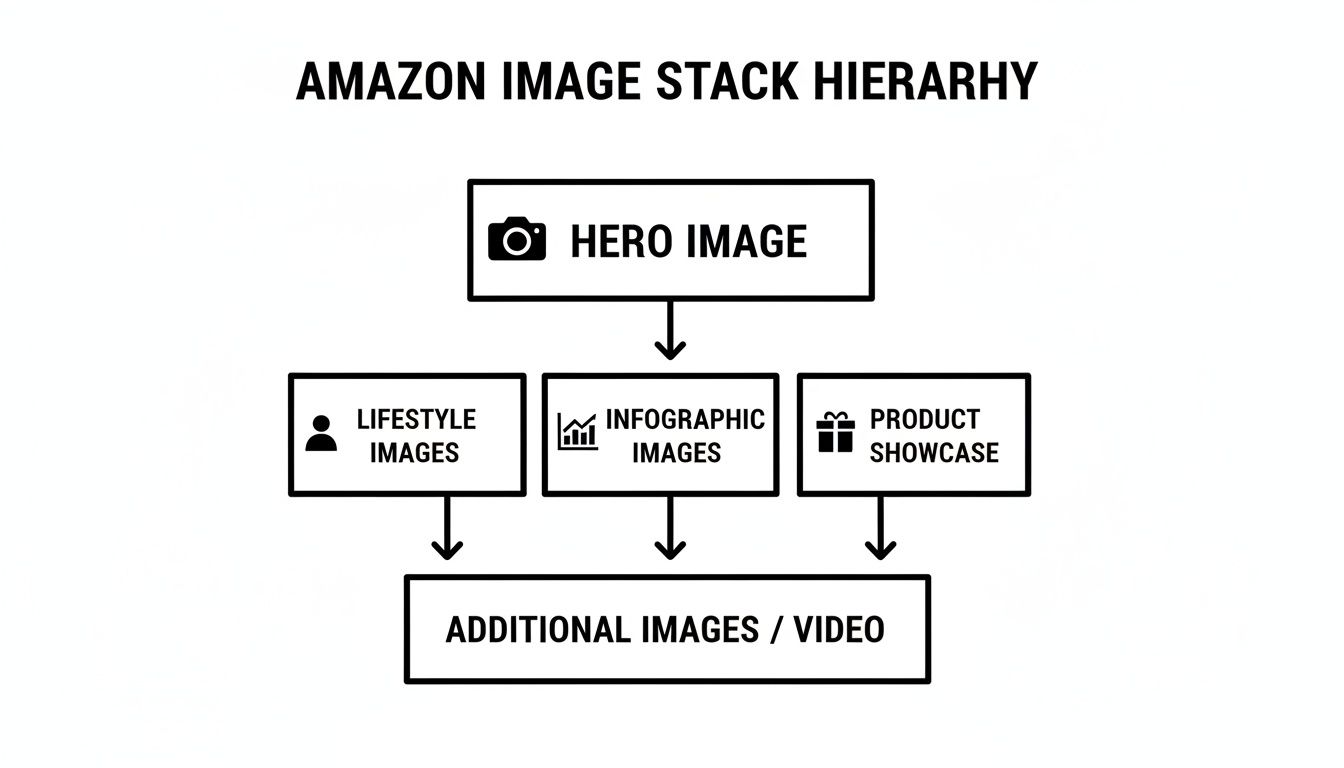
This shows that while the hero image is what earns the click, it's the lifestyle and infographic images that do the heavy lifting. They sell the product by building context, answering questions, and earning trust.
Here are the questions that separate the pros from the pretenders:
1. "Walk me through your research process before a single photo is taken." The only right answer involves a deep dive into competitor weaknesses, mining customer reviews for pain points, and analyzing search data. If they jump straight to talking about photographers or graphic designers, they are a vendor, not a partner. End the call.
2. "How do you decide which benefits and features to highlight in the infographics?" Listen for a data-driven reply. They should be talking about prioritizing the benefits that shut down the most common objections or lean into the most powerful positive feelings found in reviews. A fuzzy answer like "we highlight what makes the product great" is a tell-tale sign of pure guesswork.
3. "Can you show me an example where your images specifically targeted a major competitor's weakness?" This question tests their strategic muscle. A real expert will have an answer ready. They'll point to a project and say, "The top competitor had terrible battery life, so we made our second image a bold infographic showcasing our product's 24-hour runtime."
A common mistake is being wowed by a polished sales pitch instead of a documented process. A slick presentation is worthless. A repeatable, research-based framework for creating conversion-focused images is everything.
Choosing the right Amazon listing optimization services provider isn't about finding the best photographer. It's about finding the best strategist who just happens to use images as their weapon of choice.
Focus your vetting on their research, their strategy, and their grasp of buyer psychology. That’s how you make an investment, not just an expense.
The Optimization Process From Onboarding to Implementation
Hiring professional Amazon listing optimization services isn't about just handing off your product and crossing your fingers. It’s a tight, collaborative process. The goal is to turn solid market research into visuals that actually sell.
Let’s pull back the curtain on how a top-tier service works. They operate more like a strategic partner than a simple design shop. The whole process is built on a foundation of deep-dive research that dictates every creative choice that follows. This isn’t guesswork; it’s about engineering a visual sales pitch from hard data.

Phase 1: The Strategic Deep-Dive
The process doesn't start with a photoshoot. It starts with intense research. This is the most important part because it creates the strategic blueprint for your entire set of images. If you give a vague brief, you'll get generic, ineffective images back. Your input here is critical.
Here’s what really goes on in this phase:
- Competitor Analysis: A systematic teardown of the top 5-10 competitor listings. The goal is to spot their visual weaknesses and find the messaging gaps they've left wide open.
- Customer Review Mining: This is where the magic happens. Digging into your reviews—and your competitors'—to pull out the exact words customers use to describe their problems, what they need, and what makes them hesitate.
- Market Positioning: Figuring out your product's unique selling point and nailing down how to show it visually, making you the obvious choice for a shopper.
This all gets boiled down into a strategic brief. This document explains the "why" behind every single image we plan to create. It'll pinpoint the main benefit for your key infographic, the biggest objection to crush, and the emotional trigger for your lifestyle shots.
Phase 2: Concept and Creative Production
Once you sign off on the strategic brief, the research is turned into actual visual concepts. An efficient service will run this in focused sprints to get things done fast without cutting corners on quality.
A typical production flow looks like this:
- Concept Development: The team builds out mockups or storyboards for the infographics. They plan the shots for lifestyle and product photos, all based on the strategy we agreed on.
- Photography and Design: This is the hands-on part. It includes studio photography for your hero image, lifestyle shoots to add real-world context, and the graphic design work to create those benefit-driven infographics.
- Review and Revision Sprints: You’ll get drafts to look over. This is where we collaborate to make sure the creative direction is hitting the strategic marks. Clear, consolidated feedback from you is what keeps the project moving fast.
Phase 3: Delivery and Implementation
The final step is getting the complete, ready-to-go image stack into your hands. A professional service doesn’t just dump a folder of JPEGs on you. The assets are already optimized for Amazon's technical specs, named correctly, and ready for you to upload immediately. No technical headaches on your end.
The whole point of a tight process is to deliver a full set of research-backed images that you can deploy and A/B test right away. It takes out the uncertainty and lets you see the impact on your conversion rates fast.
This entire workflow is built for speed and impact. The right process turns a simple product page into a high-performance sales machine.
Measuring the ROI of Your Professional Listing Images
An Amazon listing optimization service isn't a cost. It's an investment, and like any smart investment, you need to know if it's actually making you money.
Forget about vanity metrics or how "good" the listing feels. The only thing that matters is whether your new images are generating more profit. We're talking about cold, hard data, not just a prettier-looking page.

Connecting Images to Core Business Metrics
Your images are the single biggest driver of conversion. It’s that simple. So, any improvement you make should show up loud and clear in your Seller Central reports.
Before you upload a single new image, you need a baseline. Pull a report for the 30 days before the change. This is your "before" snapshot. Once the new images have been live for at least 30 days, pull another report for that period.
Now, you can compare. Here are the metrics to obsess over:
- Unit Session Percentage (CVR): This is it. The big one. A jump here means more shoppers who land on your page are actually buying. It's the most direct signal that your new images are answering questions, crushing objections, and sealing the deal.
- Click-Through Rate (CTR): Your main hero image is responsible for earning the click from search results. A better hero image, tested for mobile visibility, directly increases your CTR.
- PPC Conversion Rate: You pay to send traffic to your listing through ads. If those new images are more persuasive, your ad conversion rate goes up. That means more sales for the same ad spend, which directly lowers your ACoS and improves profitability.
The Force Multiplier Effect on Rank and Profit
Here’s where it gets powerful. Strategic images don’t just work on their own; they kickstart a positive feedback loop that fuels the entire Amazon flywheel.
A higher CVR leads to more sales from the same traffic. This spike in sales velocity is a huge green flag for Amazon's A10 algorithm. It tells Amazon your product is a winner, and in return, you get rewarded with better organic search rankings.
A common mistake is seeing images as a one-and-done task. They are an active growth lever. A 5% lift in your conversion rate doesn't just mean 5% more sales; it means higher organic rank, more efficient ad spend, and fatter profit margins across the board.
This ripple effect is why images often deliver the biggest and fastest results. While a full optimization includes your title and copy, a great image stack can show results in just 4-8 weeks because sales velocity is what the algorithm craves most.
A Simple Framework for Calculating ROI
Don't get lost in complicated spreadsheets. The math here is actually pretty straightforward. You're just comparing the increase in gross profit to what you paid for the optimization service.
1. Calculate Additional Gross Profit:
- (New Average Daily Sales - Old Average Daily Sales) x Average Profit Per Unit x 30 days
2. Calculate ROI:
- (Additional Gross Profit - Cost of Optimization Service) / Cost of Optimization Service x 100
This simple formula cuts through the noise and gives you a clear percentage return on your investment. If you want a deeper dive, this guide on how to calculate marketing ROI is a great resource.
Ultimately, proving the value of professional images isn't just about justifying an expense—it's about confirming you have a winning growth strategy.
Common (and Costly) Mistakes When Hiring a Service
Hiring someone to handle your listing images is supposed to be a shortcut to growth. But for too many sellers, it becomes a fast track to a drained bank account with nothing to show for it.
Sellers trip over the same mistakes again and again. Let’s walk through them so you can avoid the headaches.
Pitfall #1: Choosing Based on Price Alone
This is the big one. Hunting for the cheapest freelancer or agency is like treating a strategic investment like a commodity. You’re not buying photos; you’re buying a conversion strategy.
When you hire for the lowest price, you almost always get what you pay for: generic images with zero strategic thought. They might look "nice," but they do nothing to answer buyer questions, crush objections, or make you stand out. The money you "saved" is instantly lost in opportunity cost.
Pitfall #2: Vague Briefs Get Vague Results
Handing over a product link and saying, "make it look good," is a recipe for failure. No one can read your mind. They don't know your customer's real problems or what makes your brand tick.
A weak brief forces the creative team to guess. That leads directly to:
- Wrong Messaging: The images highlight features you know don't matter and ignore the benefits that actually make people buy.
- Bad Lifestyle Shots: The model is wrong, the context is off, and the whole thing feels fake.
- Never-Ending Revisions: You waste weeks in back-and-forth emails fixing problems that a good brief would have prevented from the start.
The quality of what you get back is a direct mirror of the quality of what you put in. A pro service will guide you, but you have to bring the customer and brand knowledge. Skip that, and you’re guaranteed a generic result that just blends in.
Pitfall #3: Not Asking "Why?"
This is a subtle but critical mistake. You’re not hiring a pair of hands to follow orders; you’re hiring a strategic partner. It’s their job to explain the "why" behind every single image. Don't just passively accept their creative choices.
If they show you an infographic, ask: "Which specific customer objection, pulled from our reviews, does this image solve?"
If they show you a lifestyle shot, ask: "How does this scene connect with what our target buyer actually wants to achieve?"
If they can't give you a straight, data-backed answer, that’s a massive red flag. It means the images aren't being engineered to persuade, which leads directly to a drop in conversion. Challenge their logic. It forces them to prove that every pixel has one purpose: to make you more money.
Common Questions About Amazon Listing Services
Let's cut through the noise. Here are straight answers to the questions serious sellers ask when they're thinking about hiring a pro for their Amazon listing optimization.
How Long Does It Take to See Results?
You might see small bumps in clicks and impressions in a couple of weeks, but the real change—the kind you can see in your sales velocity and conversion rate—usually shows up in 30 to 60 days.
Amazon's A10 algorithm isn't instant. It needs time to see that shoppers are converting better on your page, adding your product to their carts more often, and ultimately buying. Once it registers that positive behavior, it starts rewarding your listing with better organic search placement. Be skeptical of anyone promising you page one overnight; that's not how the game is played.
Why Is There So Much Focus on Images Over Everything Else?
Because on Amazon, images sell first, and copy sells second. Think about how you shop on your phone: you scroll through pictures, making a split-second decision. Your visuals are your entire sales pitch, delivered in less than five seconds.
Keywords get people to your listing, but the images are what convince them to buy. A great set of images answers questions, handles objections, and builds trust before a shopper even glances at your bullet points. Neglecting your visuals is probably the most expensive mistake you can make as a seller.
An optimized listing with mediocre images will always lose to a decent listing with killer, strategic images. Visuals have a disproportionate impact on conversion rate, which is the ultimate driver of sales velocity and rank.
Can’t I Just Use My Manufacturer's Photos?
Please don't. Manufacturer photos are designed for B2B catalogs, not for the hyper-competitive, direct-to-consumer world of Amazon. They're generic, boring, and do absolutely nothing to connect with your specific customer's problems and desires.
Using them is the fastest way to make your product look exactly like everyone else's. A professional service digs into customer research to create custom visuals that make your product feel like the only logical choice for the buyer.
Is This Worth the Cost if My Product Is Cheap?
This isn't about your product's price tag; it's about its sales volume potential. The return on investment comes from the lift in your conversion rate (CVR).
Even a small 1-2% CVR increase on a product that sells a few hundred units a month can translate into thousands of dollars in extra profit over a year. The investment pays for itself by boosting sales velocity, making your PPC ads more efficient, and improving your organic rank—all of which compound over time. Think of it as a one-time investment in a long-term performance asset.
The question isn't whether you can afford to invest in professional listing images; it's whether you can afford not to. Every day your listing uses suboptimal visuals is another day of lost sales, wasted ad spend, and unrealized rank. Treat your images as the primary lever for growth they are. Get your conversion-focused images today.