Amazon Listing Images Service: A Guide To Driving Conversion
An Amazon listing images service isn't about "pretty pictures." It's a conversion optimization service that uses visual assets to increase your revenue.
Unlike a generic photographer, a true Amazon image service is obsessed with buyer psychology and data. They don't create a gallery; they build a visual sales pitch engineered to justify a higher price, amplify PPC efficiency, and systematically convert browsers into buyers.
Your Images Are a Sales Team, Not a Gallery
Stop thinking of your product images as a creative expense. They are the single highest-leverage investment you can make to improve performance on Amazon. Period.
Your copy, A+ Content, and backend keywords are secondary. They only matter after a shopper clicks on your listing. Your images do the initial, and most critical, heavy lifting.
The modern Amazon shopper makes snap judgments in milliseconds based on one thing: your main image. Before they read a single bullet point, they've already decided if your product looks cheap, trustworthy, or is the solution they need. This first impression dictates your click-through rate (CTR), a primary signal Amazon's algorithm uses to determine organic rank and ad relevance.
The Real Cost of "Good Enough" Images
Most sellers operate in the "good enough" zone—a few decent photos on white, maybe a basic feature callout. In a competitive market, this is a recipe for failure.
"Good enough" is invisible. It blends into a sea of mediocrity, forcing you to compete on the only lever you have left: price.
An expert Amazon listing images service operates from a different playbook. It’s not about art; it’s about building a visual argument rooted in research.
Your Amazon images aren’t just showing a product. They are systematically dismantling buyer objections, building perceived value, and creating an emotional connection before a customer ever reads your description.
Images as a Force Multiplier for Your Business
Investing in strategic images creates a competitive moat. While your competition races to the bottom on price, you're building a brand asset that communicates quality and justifies a premium.
Think of this investment as a force multiplier for your entire Amazon operation:
- PPC Efficiency: A superior main image earns more clicks. A higher CTR improves your ad relevance, which can lower your cost-per-click (CPC) and Advertising Cost of Sale (ACoS).
- Higher Price Tolerance: Professional visuals build perceived value, giving you the power to command a premium price without depressing sales velocity.
- Increased Conversion Rate (CVR): A full image stack that anticipates questions, demonstrates benefits, and builds trust eliminates friction and drives more add-to-cart actions.
Your images are your best salesperson, working 24/7. Treating them as an afterthought is leaving money on the table.
The Deliverables of a Strategic Amazon Image Service
Hiring a professional Amazon listing images service is not the same as buying a photo package. You're investing in a strategic set of visual assets where every image has a specific conversion-focused job.
Amateurs deliver pretty pictures. Professionals deliver a visual sales funnel that guides a shopper from the search results page to the “Add to Cart” button.
A critical component is high-quality product photography for Amazon. But the photos are just the foundation. The strategy layered on top—the infographics, lifestyle context, and comparison charts—is what turns a good listing into a high-converting one.
The 7-Image Stack That Converts
A complete package from a top-tier service provides a full set of seven images. Each plays a specific role in answering buyer questions and building confidence.
This isn't an arbitrary number—it's the maximum visual real estate Amazon provides. Leaving any slot empty is a wasted opportunity. Your image carousel must function as a cohesive sales presentation, addressing concerns and highlighting benefits with every swipe.
A high-performing image set starts with the fundamentals and then systematically dismantles every reason a customer might hesitate. Here’s what a strategic deliverable checklist looks like.
Standard Deliverables From a Strategic Amazon Image Service
The table below breaks down the seven essential images every listing needs. Note how each image type is tied to a specific conversion goal. This isn't about filling space; it's about engineering a sale.
| Image Slot | Image Type | Primary Conversion Goal |
|---|---|---|
| Image 1 | Hero Image | Earn the click from search results (CTR) |
| Image 2 | Lifestyle Image | Help the shopper visualize the benefit in their life |
| Image 3 | Context/"In-Use" Image | Show the product actively solving a specific problem |
| Image 4 | Benefit-Focused Infographic | Translate a key feature into a tangible outcome |
| Image 5 | Benefit-Focused Infographic | Highlight a secondary benefit or overcome a known objection |
| Image 6 | Comparison Chart | Position your product as the obvious choice vs. alternatives |
| Image 7 | Trust-Builder / "What's in the Box" | Remove final risk (warranty, contents, setup instructions) |
This structure isn't a suggestion; it's a proven framework that aligns directly with buyer psychology on Amazon.
Why Infographics and Comparison Charts Are Non-Negotiable
The main image earns the click, but the secondary images secure the sale. This is where a strategic service proves its value by converting research into visuals that crush objections.
The most effective secondary images are built from research, not guesswork. They systematically address the top questions, concerns, and pain points mined from competitor reviews and customer Q&As.
These are not simple feature callouts. A professional service translates technical specs into tangible benefits. Instead of saying “10,000 mAh battery,” a strong infographic shows “Charges your phone 3 times,” paired with simple icons designed for scannability on a mobile screen.
The Comparison Chart is your knockout punch. It pits your product against a generic competitor, making it painfully obvious why yours is the superior choice. It is the single most effective tool for justifying a higher price point.
Finally, the Trust-Builder image closes the deal. It might showcase a warranty, detail what’s included in the box, or provide a simple "how-to" diagram. It’s the final nudge a hesitant buyer needs.
Think of it as a funnel. Your main image has one job: get shoppers to click from the search results onto your product detail page.
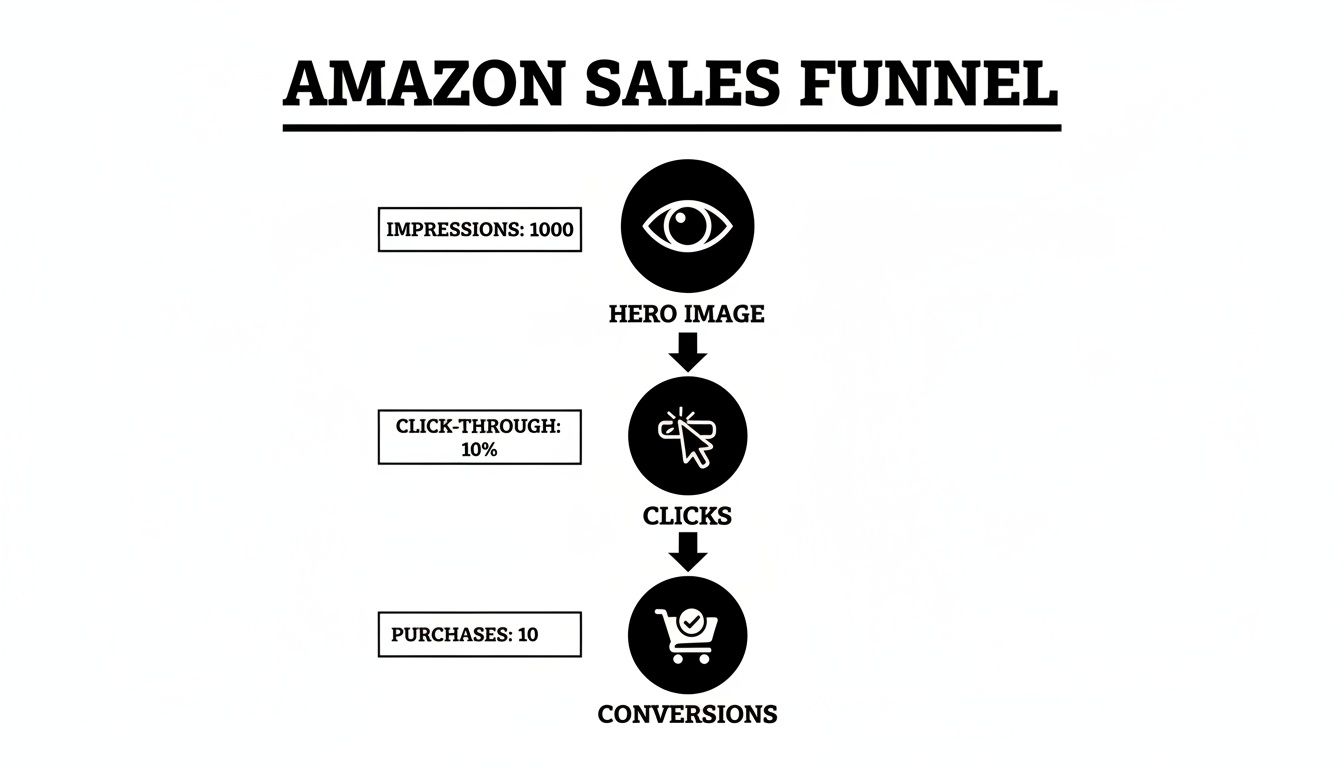
If that first image fails, nothing else matters. The rest of your visual sales pitch is never seen.
The Research-Driven Process That Separates Pros From Amateurs
Any competent graphic designer can create a visually appealing image. But on Amazon, "pretty" doesn't sell—strategy does. The core difference between a generic designer and a high-impact Amazon listing images service is one thing: deep-dive research.
Without it, you're just guessing. You're throwing visual spaghetti at the wall and hoping something sticks—a fantastic way to burn through your budget with zero impact. A professional service builds a visual sales argument on a foundation of data. Every pixel has a purpose.
This isn't about artistic talent. It’s about methodically reverse-engineering what motivates your ideal customer to buy.

Uncovering Visual Gaps With Competitor Analysis
First, you must map the competitive landscape. A top-tier service dissects the entire first page of search results to identify patterns and, more importantly, weaknesses to exploit.
This analysis goes beyond noting color schemes or photo quality. It's a strategic teardown of the competition's visual messaging.
- What benefits are they emphasizing? Durability, ease of use, a specific outcome?
- What objections are they ignoring? The most common complaints in their reviews are your opportunities.
- What is their visual hierarchy? What do they show first, and is it effective?
- Is there a visual angle everyone else has missed? The biggest win is often showing the product in a context no one else has considered.
By identifying these gaps, a data-driven service positions your images to be the immediate solution. Your visuals become the answer to the questions your competitors are forcing shoppers to ask.
Mining Reviews for Conversion Gold
Your competitors' customer reviews are a goldmine of unfiltered feedback. This is the most direct line into the buyer's brain, telling you exactly what they care about and what their pain points are. A professional service sifts through hundreds of reviews to find recurring themes.
The goal of review mining is to find the exact words customers use to describe their problems and desires. These phrases become the source material for infographic headlines, lifestyle scene concepts, and benefit callouts.
Instead of guessing which features matter, this process tells you. If dozens of reviews for a rival blender complain that it's "impossible to clean," one of your images must show your blender rinsing clean in seconds with the headline "Cleans in Under 30 Seconds."
This approach transforms vague product features into powerful, problem-solving benefits that resonate instantly.
Aligning Images With Search Intent
Finally, you must understand how customers search. Are they typing in broad terms like "yoga mat," or a specific solution like "extra thick yoga mat for bad knees"? Each query reveals a different primary motivation.
Analyzing search intent helps a service prioritize which benefits to feature most prominently.
- Identify High-Volume Search Terms: This reveals the primary reasons people are shopping for your product category.
- Analyze "Long-Tail" Keywords: Specific searches (e.g., "non-slip yoga mat for hot yoga") expose niche pain points and desired outcomes you can address visually.
- Translate Intent into Visuals: If "travel friendly" is a common search modifier, an image showing your product packed neatly in a suitcase becomes a critical selling asset.
This research isn't a "nice-to-have." It is the strategic foundation. It’s what allows an Amazon listing images service to move beyond decoration and create a high-performance sales tool. Without this analytical rigor, you're not optimizing; you're just guessing. To dive deeper into how this process informs brand storytelling and other visual content, you can find more insights on our blog about Amazon strategy.
Don’t Get Your Listing Suppressed by Amazon’s Image Rules
Strategy and psychology are useless if your images get your listing suppressed.
It’s a costly and avoidable mistake, yet sellers get flagged daily for basic compliance violations. Amazon's technical image requirements are not suggestions—they are rigid rules enforced by its algorithm.
Ignore them, and your listing can disappear from search results without warning, instantly killing sales velocity and organic rank. A professional Amazon listing images service not only builds a visual strategy but guarantees every pixel meets Amazon's strict technical standards, eliminating that risk.
The Main Image: Your Non-Negotiable First Impression
Your main "hero" image is under the most scrutiny. Amazon's goal is a clean, uniform shopping experience, and your main image is the gatekeeper.
The rules are absolute:
- Pure White Background: The background must be RGB 255, 255, 255. No off-white, no light gray, no poor cutouts.
- Product Only: The image must show only the product. No logos, badges, text, or watermarks.
- Fill the Frame: The product must occupy at least 85% of the image space for clear visibility, especially as a mobile thumbnail.
These rules exist to build customer trust and reduce visual chaos. Breaking them doesn't just risk suppression; it damages the user experience.
Why 3000x3000 Pixels Is the New Standard
Amazon's technical specifications have evolved. To enable the critical zoom feature, images must be at least 1,000 pixels on the longest side.
But the professional standard has shifted. The baseline for a premium mobile-first experience is 3,000 by 3,000 pixels. You can get a deeper dive into how these technical details impact user experience from WakeupData. This high resolution delivers a crystal-clear zoom, allowing shoppers to inspect every detail, which is proven to increase conversion.
A low-resolution image that disables the zoom function is a massive red flag for buyers. It suggests you have something to hide and creates immediate friction, often leading to a lost sale.
The final technical details are just as critical. All images should be a JPEG, TIFF, PNG, or GIF, though JPEG offers the best balance of quality and file size. They also need to be in the sRGB or CMYK color mode.
These details seem minor, but getting them wrong can cause image distortion or outright rejection. A professional service manages this entire technical checklist so you can focus on strategy, not file formats.
How to Hire the Right Amazon Listing Images Service
Choosing an Amazon listing images service is a business decision, not a creative one. You are not hiring an artist. You are hiring a conversion strategist.
The wrong choice leads to wasted ad spend, endless revisions, and images that fail to perform. The right choice delivers a predictable, high-ROI asset that powers your entire Amazon business.
Too many sellers are swayed by flashy portfolios of "pretty" pictures that lack strategic depth. You need a partner who thinks like a data-driven marketer first and a designer second. When you're vetting options, it can be helpful to see how top-tier marketing Agencies are evaluated—they are judged on measurable outcomes, not just aesthetics.
Look for Process Over Polish
Any decent designer can create an appealing image. What matters is the logic behind it. The first thing you must investigate is their process. If they cannot articulate a clear, research-driven system, they are not the right partner.
A true professional will lead with their research framework. They should be able to explain exactly how they handle:
- Competitor Analysis: How do they deconstruct top listings in your niche to find visual weaknesses and positioning opportunities?
- Review Mining: What is their system for extracting customer pain points, desired benefits, and specific phrasing from reviews to build your infographics?
- Search Intent Analysis: How do they ensure the most important benefits are communicated instantly based on what customers are actually searching for?
If their answer is vague or they just ask for your brand guidelines, they’re a decorator, not a conversion specialist.
Scrutinize the Portfolio for Conversion Focus
Next, analyze their portfolio like a skeptical buyer. Ignore the high-quality photography and ask what strategic job each image in the carousel is performing.
A portfolio showing only polished hero shots is a massive red flag. You are looking for proof that they can construct a complete visual sales argument, from the click-driving main image to the objection-crushing comparison chart.
As you review their work, ask:
- Is the Information Hierarchy Clear? Can you grasp the main point of an infographic in under three seconds on a mobile screen?
- Do the Lifestyle Images Feel Authentic? Do they look like real people solving a real problem, or are they cheesy, generic stock photos?
- Does the Comparison Chart Make a Decisive Case? Does it position their client's product as the obvious, superior choice?
- Is There a Clear Narrative? Does the image set tell a cohesive story that guides a shopper from interest to purchase, or is it a random collection of images?
Demand Clarity on Pricing and Revisions
Finally, you need a partner who operates with total transparency. The last thing you want is a project bogged down by hidden fees, surprise charges, and endless revision cycles.
A confident, professional service will offer clear, flat-rate pricing. They should deliver a complete, Amazon-compliant image set for a single, predictable cost. Vague, hourly-based pricing models are often a sign of inefficiency. You can explore our straightforward pricing and order process to see an example of this clarity.
Their revision policy should also be simple. A service with a robust research process shouldn't require numerous revisions. An "unlimited revisions" offer can paradoxically signal a lack of confidence in their own strategy. A better model is a satisfaction guarantee built on a proven, data-informed process from the start.
Calculating the True ROI of Strategic Listing Images
Most sellers view professional images as an expense. This is a fundamental mistake. An amazon listing images service isn't a cost—it's a direct investment in your single most powerful sales asset on the platform.
The return is measured in cold, hard improvements to your unit economics and bottom line. Strategic images act as a force multiplier for your entire Amazon business.
They create a positive feedback loop with Amazon's A9 algorithm. Better images lead to a higher conversion rate. Amazon interprets this as a strong signal that customers prefer your product. The algorithm rewards you with higher organic rank, which drives more traffic, leading to more sales—a virtuous cycle of growth.

Driving Down Ad Spend and Increasing Price Tolerance
The impact on your PPC campaigns is immediate. A listing that converts better means more of your ad clicks turn into sales. This directly lowers your Advertising Cost of Sale (ACoS), allowing you to bid more aggressively or simply increase profitability. Every ad dollar works harder because every click has a higher probability of success.
Simultaneously, superior images build perceived value. They communicate quality, trust, and a premium experience before a shopper reads a single word.
When your product looks superior to the competition, customers become far less sensitive to price. This gives you the power to command a higher price, which flows directly to your bottom line and increases your profit margin on every unit sold.
This isn't a trick. It's about accurately representing the quality of your product and brand. It is common for sellers to increase their price by 5-15% after an image optimization without any negative impact on sales velocity.
A Capital Investment with a Clear Payback
Treat your image set as a core business asset, just like inventory or manufacturing equipment. It is a one-time investment that pays dividends across the entire Amazon flywheel—from traffic and conversion to profitability and rank.
Here’s a simple breakdown of the financial impact:
- Improved Conversions: A 1% increase in CVR can fundamentally change your monthly revenue and profit.
- Lower ACoS: More efficient ad spend means more profit from every ad-driven sale.
- Higher ASP: Increased pricing power directly boosts your Average Selling Price and margins.
- Stronger Organic Rank: Better conversion feeds the algorithm, reducing your long-term reliance on paid traffic.
This makes professional image creation one of the smartest capital allocations a brand can make. The investment is predictable, the impact is measurable, and the return is substantial. We believe in this so strongly that our work is backed by a clear guarantee, detailed in our refund policy.
The takeaway is simple: strategic images aren't a cost center. They are a primary driver of profitability.
Common Questions from Sellers
When considering a professional service for your Amazon listing images, a few critical questions always arise. Here are the direct answers for experienced sellers.
How Long Until I Get My Images?
A well-oiled, research-driven process should deliver a complete set of listing images in 3-5 business days. Speed is critical. You need to launch a new product or fix an underperforming listing without losing sales momentum. A service quoting weeks likely has a bloated process not optimized for the pace of Amazon.
Do I Have to Supply My Own Photos?
Not necessarily. A top-tier service can work with existing high-resolution photos. However, a superior option is a service that can create a full set of photorealistic 3D renders from just a few reference photos of your product. This eliminates the need for a costly, time-consuming photoshoot—a significant advantage for speed-to-market and showcasing product variations without shooting each one.
What's the Real Difference Between a Pro Service and a Freelancer?
The difference is strategy. A good freelancer can execute your instructions to create pretty pictures. A professional service builds a visual sales argument based on market data.
You are not just paying for design skill; you are paying for a repeatable, data-driven process. A strategic service starts with deep analysis—competitor teardowns, review mining for pain points, and search intent mapping. Every image is then engineered to overcome a specific objection and drive a conversion. A freelancer typically just executes your brief.
Is This Really Worth It for a Cheaper Product?
Absolutely. It is arguably more important for products in competitive, low-margin categories. When margins are thin, your conversion rate is everything. Increasing your CVR by just 1-2% can be the difference between a profitable product and one that hemorrhages ad spend.
Strategic images directly improve your unit economics by:
- Boosting Conversion Rate: You generate more sales from the same amount of traffic.
- Slashing Your ACoS: Better conversions make your PPC spend more efficient.
- Justifying Your Price: Superior visuals build perceived value, allowing you to avoid a race to the bottom on price.
The investment pays for itself quickly through improved profitability and stronger organic rank. It is one of the highest-leverage investments you can make in your Amazon business.
Stop guessing and start selling with images engineered to convert. ProductShots delivers a complete, research-driven image set in days, guaranteed to lift your conversion rate.